The Intimacy Imperative
As digital life grows louder and more performative, the most valuable experiences are the ones that resist documentation—and reward full presence



The End of the Experience-as-Content Era
Over the last decade, experiences have been engineered as content—optimized for virality, visual validation, and limitless digital reach. However, Trend Hunter's emerging experience insights suggest this model is beginning to fracture. Increasingly, consumers are rejecting experiences designed primarily for documentation and sharability in favor of those that feel emotionally immersive and difficult to replicate online. We are entering an era where the value of an experience is increasingly inversely proportional to its shareability. What cannot be captured, posted, or replicated now carries the greatest cultural and emotional weight.
Enter: The Intimacy Imperative
The "Intimacy Imperative" marks a structural reset in the experience economy, shifting the focus from broadcast to resonance. This megatrend defines the next phase of engagement: experiences rooted in privacy, friction, intentional scarcity, and emotional depth.
Drawing from Trend Hunter's tracking of offline socialization, analog leisure, micro-community dining, phone-free entertainment, and invite-only ecosystems, this shift reflects a broader cultural movement away from performative participation and toward curated presence.
By rejecting the performative standards of the social media era, brands and creators are moving away from scale and toward curation, designing environments protected from algorithmic extraction and constant visibility.
Presence Is the New Premium. In this new paradigm, the most premium experiences are no longer those that allow people to signal attendance, but those that demand full presence. The objective is no longer to cultivate an audience, but to facilitate authentic connection—one that, by its very nature, resists documentation.
The Analog Rebellion: Why Consumers Are Rejecting Shareability
The "Year of Analog" marks a cultural correction to the hyper-documented digital era. After years of living through screens, consumers are gravitating toward offline-first, phone-free, and intentionally undocumented experiences that prioritize presence over performance.
According to Eventbrite's recent Offline by Design report, this shift is reflected in the global rise of phone-free events (+567%), alongside growing demand for spontaneity and less curated interaction—particularly among Gen Z, 49% of whom want less curated experiences, while 79% prioritize spontaneity over aesthetic perfection.
Trend Hunter has tracked this movement across signals such as Offline Dating Experiences, Phone-Free Music Festivals, Reading Rhythms, Soft Clubbing, Analog Hobbyfication, and Off-Grid Hospitality.
Emerging behaviors include analog dating formats, silent reading parties, sealed-phone concerts, offline social clubs, and unplugged luxury hospitality concepts that frame disconnection as a premium amenity. These experiences replace performative participation with immersion, emotional presence, and sensory grounding.
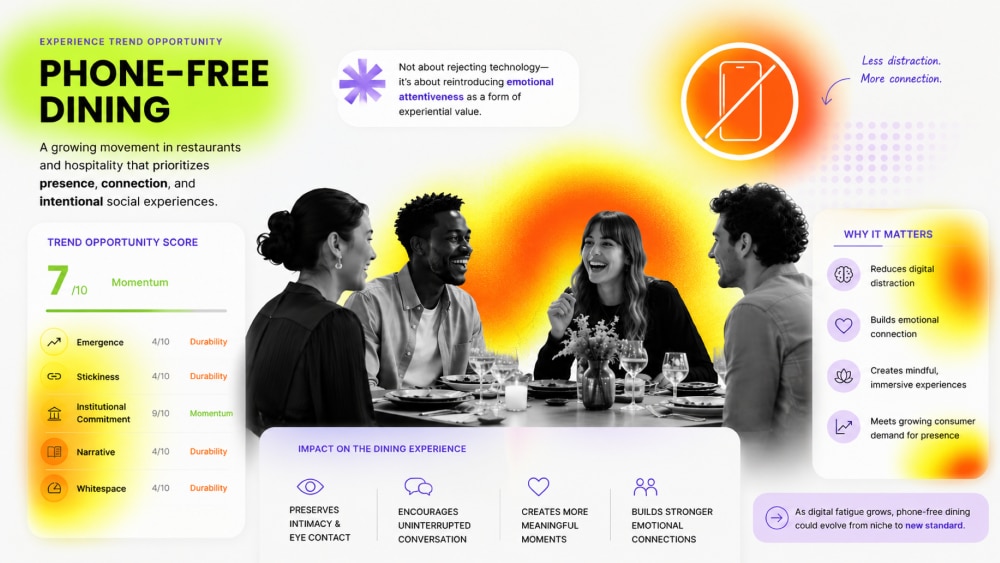
One particularly notable whitespace opportunity identified within Trend Hunter's Trend Intelligence Engine is Phone-Free Dining, which combines strong institutional momentum with relatively low saturation. This opportunity reflects growing consumer demand for dining environments that preserve intimacy, eye contact, and uninterrupted conversation.
 Trend Hunter
 Restaurants and hospitality brands are introducing phone-free dining concepts, communal rituals, and immersive social experiences to encourage meaningful human connection and reduce digital distraction. The trend is less about rejecting technology and more about creating emotionally attentive, mindful experiences that deepen social engagement. As digital fatigue grows, phone-free dining could shift from a niche experiment into a mainstream hospitality standard focused on presence, connection, and intentional interaction.
Strategic Takeaway: The opportunity for brands is to create experiences that lose value when documented and gain value when fully lived.
The Micro-Community Era: From Mass Reach to Meaningful Belonging
Curated micro-communities are small, highly intentional networks organized around shared interests, identities, or lifestyles. Positioned between one-to-one relationships and mass social platforms, they reflect a broader shift away from algorithmic socialization toward smaller, high-trust ecosystems built on participation, emotional safety, and belonging. As digital fatigue and social oversaturation grow, consumers are prioritizing depth over reach, seeking environments where connection feels meaningful rather than performative.
Emerging formats include anti-algorithm dinner parties, activity-based gatherings, and micro-intimacy events capped at 8–12 people to encourage organic interaction and reduce social fatigue. Trend Hunter has identified this shift through concepts such as Dinner With Friends, The Girls NYC, The Aperitivo Society and emerging "culinary connection" formats that reposition dining as a tool for belonging rather than consumption. Platforms like Timeleft and communal gathering concepts like The Longest Table similarly transform shared meals into mechanisms for emotional connection and social discovery.
Simultaneously, phone-free experiences like RhythmRx and Unplugged Morning Hangs reframe socialization around immersion and presence rather than digital multitasking. The result is a growing preference for environments that feel emotionally safe and intentionally intimate.
Strategic Takeaway: The opportunity for brands is to foster belonging without overexposure, creating spaces that feel exclusive through participation, trust, and shared values rather than price alone.
The Rise of the Intellectual Influencer: Why Deep Thinking Is Becoming a Status Symbol
The "Intellectual Influencer" represents a new class of creators whose primary currency is knowledge, analysis, and cultural interpretation rather than lifestyle aspiration alone. Blending creator-culture mechanics with expertise-driven commentary, these individuals transform books, ideas, research, and criticism into compelling forms of influence. As audiences reach "peak content," there is growing demand for creators who prioritize depth, context, and credibility over visibility and volume.
Trend Hunter has tracked this evolution through patterns like Literary Edge, reading-based social communities, lecture cafés, and intellectually driven creator ecosystems. This shift is fueling the rise of platforms like Substack and Discord communities that position learning and critical thinking as new forms of cultural capital.
Increasingly, knowledge is becoming a source of identity and belonging, with audiences gravitating toward creators who help interpret culture rather than simply promote products or aesthetics.
The rise of BookTok, Vogue's declaration of the "Era of the Bookish Influencer", and celebrity-led communities like Emma Roberts' Belletrist and Dua Lipa's Service95 Book Club reflect growing demand for intellectually enriching engagement rooted in curiosity, dialogue, and shared values.
In an AI-saturated content landscape, deep thinking itself is becoming a status symbol.
 Shutterstock / Anton Vierietin
 Strategic Takeaway: The opportunity for brands is to act as cultural interpreters, contributing ideas—not just content—and building communities around shared intelligence, perspective, and meaningful discourse.
The New Luxury of Gatekeeping: Why Restriction Is Becoming Desirable
The "New Luxury of Gatekeeping" reflects a cultural shift where exclusivity is no longer perceived as elitism, but as a form of preservation. After years of hyper-accessibility and algorithmic overexposure, consumers increasingly value environments where meaning, intimacy, and community norms are protected through intentional boundaries.
Scarcity is shifting from price-driven to access-driven, with the most desirable experiences feeling earned rather than publicly available.
This mindset is shaping nightlife, retail, wellness, and digital culture. Invite-only venues tracked by Trend Hunter like Empyrean Club use discretion and word-of-mouth to preserve atmosphere and emotional safety, while application-based communities such as Jarritos NFTs prioritize cultural alignment over mass participation.
In addition, Vogue's recent exploration of intentional gatekeeping highlights how withholding access has become a strategy for protecting taste and subculture integrity. According to Adweek, brands are also entering a post-follower era that prioritizes engagement quality over scale, while the rise of interest media, as explained by BrandKitHQ, reflects growing demand for niche ecosystems rooted in expertise, specificity, and shared values.
In an era defined by oversharing, restricted access increasingly signals authenticity, trust, and emotional depth, turning curation itself into a contemporary status symbol for culturally conscious consumers.
Strategic Takeaway: Brands should introduce productive friction, ensuring growth enhances rather than dilutes cultural meaning, emotional resonance, and community identity.
The Shift From "Look at This" to "Be Here"
The Intimacy Era reflects a broader cultural redefinition of what consumers value and seek from brands—evolving from "Look at this" to "Be here." As digital life becomes increasingly saturated and performative, consumers are gravitating toward experiences that feel more intentional, emotionally grounded, and genuinely connective.
Trend Hunter's broader experience tracking suggests that the next generation of premium engagement will be defined less by visibility and scale and more by depth, trust, and presence over constant visibility.
The Future Belongs to Semi-Visible Brands
As audiences move away from performative consumption and toward meaningful participation, brands have an opportunity to redefine engagement through trust, curation, and community.
Moreover, the return of gatekeeping suggests that the most valuable brands will operate within semi-visible ecosystems, growing selectively while maintaining cultural integrity.
Designing for Presence, Not Attention
Looking ahead, the most impactful brands in 2026 will not be those that demand constant attention, but those that create environments where consumers feel genuinely seen, connected, and present—offering forms of value that cannot be replicated by algorithms or measured purely through reach.
At the center of this shift is a critical question for innovators: How is your brand creating value that is felt deeply, shared selectively, and protected from overexposure?