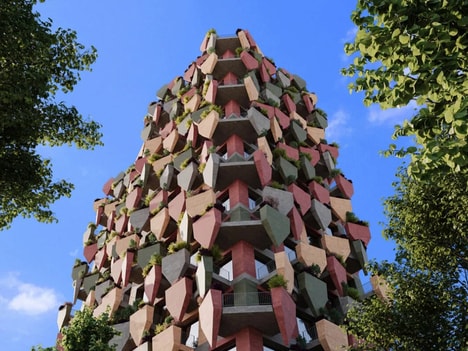
Plants are amazingly adaptable, and Plane-Tree-Cube Nagold shows how this adaptability can be put to use for environmentally friendly architecture. The cubic structure redefines the concept of a tree house by being a structure literally made out of living trees.
Plane-Tree-Cube Nagold is a long-term project by Ludwig.Schoenle, a German architect. The structure is in the German city of Nagold, and it brings the environment into an urban context. It consists of a latticed steel cube with the dimensions of a mature tree. The architects placed young plane trees around six levels on the structure. As these trees grow, the upper portion of Plane-Tree-Cube Nagold will be covered by the trees' canopy while the lower part will thin out and be dominated by the thick trunks.
Eventually, Plane-Tree-Cube Nagold will be a cube of fully grown interlaced plane trees.
What's Driving This Trend
- Living Architecture
- The use of living trees as building materials opens up opportunities for sustainable and environmentally friendly architectural designs.
- Integration of Nature
- The integration of trees and plants into urban structures allows for the creation of unique and aesthetically pleasing environments.
- Adaptive Structures
- Tree-embedded cube structures demonstrate the potential for buildings that can adapt and grow with their surroundings.
Who This Affects Most
- Sustainable Architecture
- The trend of using living trees in architectural designs presents opportunities for sustainable architecture firms to create innovative and eco-friendly structures.
- Urban Planning
- The integration of nature into urban structures is a trend that urban planning professionals can explore to create more sustainable and livable cities.
- Construction
- The construction industry can embrace the trend of adaptive structures to develop new construction methods that incorporate living materials and natural elements.