
Trend Intelligence Engine: Trend Tracking
to Trend Action
The Trend Intelligence Engine (TIE) is Trend Hunter’s proprietary system for identifying, validating, and prioritizing emerging trends - scanning thousands of signals, including proprietary intelligence from 90M+ Americans, to reveal which have real momentum and staying power.
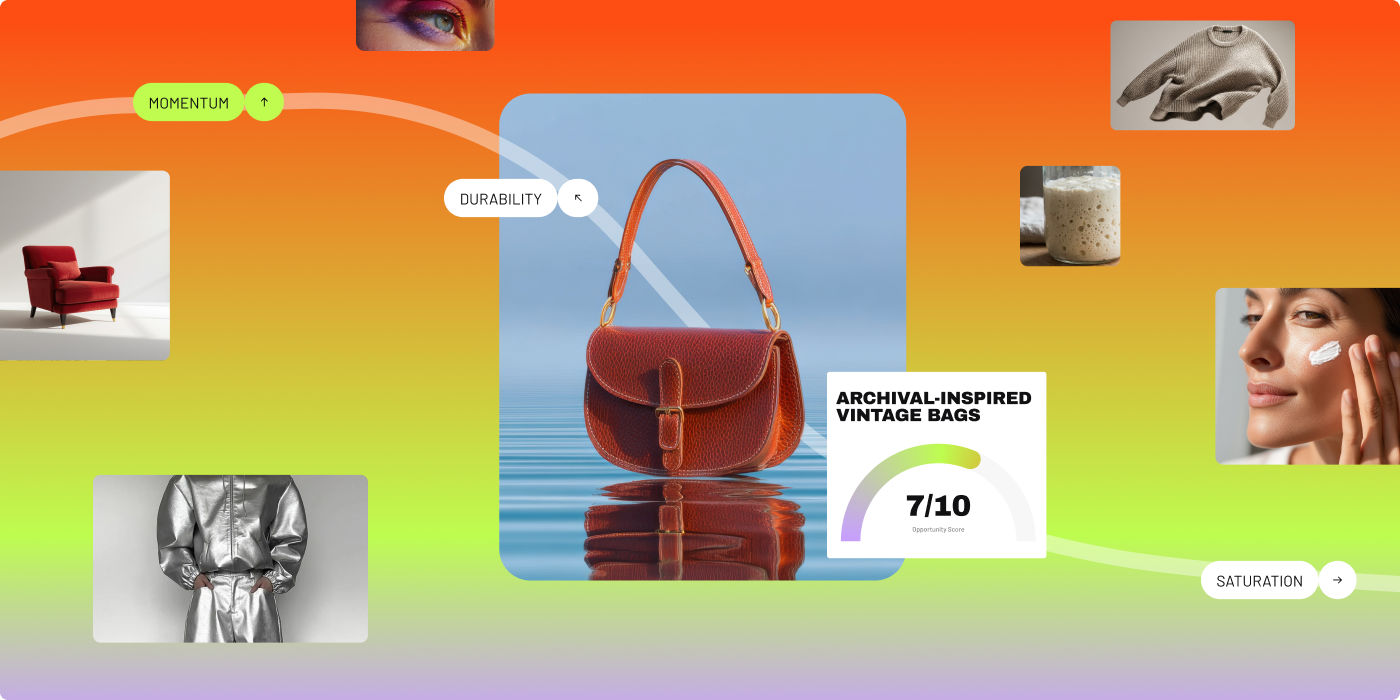
Trend Hunter’s methodology moves beyond views and social commentary to understand how trends are developing, what is driving them, and what kind of opportunity they may represent.
Schedule a Call →Trend Intelligence Engine
At the foundation of our methodology is the Trend Intelligence Engine (TIE). TIE aggregates signals from a wide range of sources, including:
- → Social and Community Activity
- → Pricing and Transaction Indicators
- → Consumer Behavior Signals
- → Proprietary Research, Surveys, and Polling
- → Industry and Innovation Activity
- → Proprietary Consumer Intelligence from over 90M Americans
- → Media and Narrative Analysis
The Opportunity Score
Based on the TIE signals, each trend is given an Opportunity Score. The Opportunity Score helps assess the nature of an opportunity, rather than just popularity.
Emergence
How quickly and visibly a trend is gaining traction.
Stickiness
Whether it is becoming a repeat behavior or embedded habit.
Institutional Commitment
The level of long-term investment from organizations.
Narrative
How the conversation is evolving from attention to real-world value.
White Space
The opportunity to expand into new audiences, use cases, or industries.
The Opportunity Score uses a weighted model where each lens plays a different role. Weighting can shift by category or industry, so the score reflects the signals that matter most in that specific market.
Schedule a Call →
These factors help identify where a trend sits today and how organizations may choose to respond.
Three Stages of Opportunity
Every trend represents an opportunity. The question is what kind.
Momentum
Early-stage signals with significant room to grow.
Durability
Established signals with proven staying power.
Saturation
Widely adopted trends with strong market validation.
Typical Actions:
- Monitor closely
- Run pilots
- Test new concepts
- Build early learning before the market matures
Typical Actions:
- Invest with confidence
- Build internal capabilities
- Develop longer-term initiatives
- Secure stakeholder buy-in
Typical Actions:
- Differentiate your approach
- Look for adjacent white space
- Compete where capabilities already exist
- Focus on execution and positioning
Human Expertise
Turns Signals Into
Strategy
Our Insights Analysts and Client Solutions teams translate the TIE signals into business implications, helping clients understand what is changing, why it matters, and where opportunity exists. Our team translates emerging patterns into recommendations, helping organizations understand:
- What is changing
- Why it matters
- What opportunities are emerging
- What actions are worth considering next
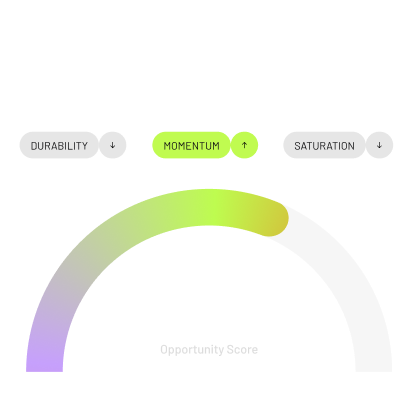
Every analysis combines quantitative validation with human expertise to provide context, interpretation, and strategic recommendations.
FAQ
The Trend Intelligence Engine is Trend Hunter’s proprietary system for identifying, validating, and prioritizing emerging trends. It scans thousands of signals across social, consumer, industry, media, and proprietary Trend Hunter data sources to help determine which trends have real momentum, staying power, and strategic relevance.
Rather than simply showing what is popular, TIE helps teams understand which signals are worth watching, testing, investing in, or avoiding.
The Opportunity Score is the scoring system powered by the Trend Intelligence Engine. It evaluates each trend across five factors: Emergence, Stickiness, Institutional Commitment, Narrative, and White Space.
Together, these factors help separate short-term hype from stronger opportunities with clearer strategic potential. Each scored trend is categorized into one of three stages: Momentum, Durability, or Saturation.
Traditional trend reports typically show what is trending or gaining visibility. TIE goes further by assessing whether a trend is likely to last, how much opportunity remains, and what kind of action may make sense.
This shifts trend work from inspiration alone to more confident decision-making, helping teams prioritize where to focus, what to test, and how to build a stronger case for action.
Yes. The Trend Intelligence Engine can be adapted by category or industry. Different industries may require different data sources, signal types, or factor weightings depending on how trends emerge and mature in that space.
For example, a retail trend may rely more heavily on institutional investment, merchandising shifts, and competitive movement, while a food or CPG trend may rely more on consumer behavior, repeat usage, and product adoption signals.
TIE is not designed to make guaranteed predictions. It is designed to identify signals that are gaining meaningful traction and assess whether they have the potential to shape a category over the next 12 to 24 months.
In practice, this gives teams an earlier read on which opportunities may be worth acting on before they become obvious or saturated.
TIE is currently strongest in Food & Beverage and CPG, where the model has the deepest testing and strongest source coverage.
Expansion into Retail and Tech is underway, with additional categories expected to be added as the model is tested, refined, and supported by stronger category-specific data sources.
TIE draws from a mix of public, proprietary, and category-specific data sources. This includes social and community data, consumer behavior signals, pricing and transaction indicators, hiring and organizational signals, media and narrative analysis, product and industry movement, and Trend Hunter’s own ecosystem of readership, engagement, and proprietary data.
The goal is not to rely on one signal alone, but to confirm trends across multiple types of evidence.
Recommendations are generated by analyzing how a trend performs across the Opportunity Score factors and what stage it falls into.
A Momentum trend may be best suited for monitoring, piloting, or early testing. A Durable trend may support stronger investment, capability-building, or leadership buy-in. A Saturated trend may still be useful, but often requires differentiation, adjacency, or a sharper execution strategy.
The score provides the data-backed foundation, while Trend Hunter’s analysts and advisors translate that into strategic guidance for the client’s category, goals, and timing.