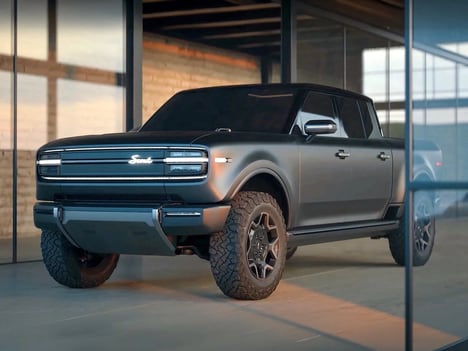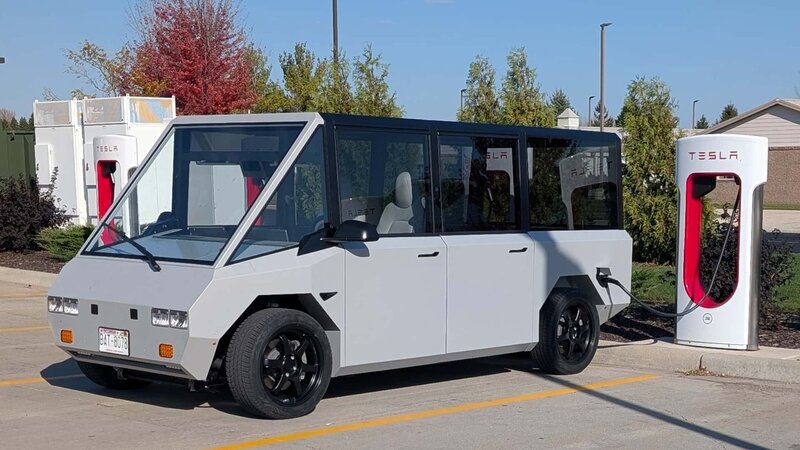
Hoffman EV is preparing the ‘Badger,’ which converts old or wrecked Teslas into an 11-seat bus or another body style. For buyers reusing a ‘Model 3’ or ‘Model Y,’ it retains Tesla controls, Supercharger access and Tesla’s ‘Full Self-Driving (Supervised)’ driver-assistance system.
The first ‘Badger’ traveled from Wisconsin to SEMA in Las Vegas, demonstrating that the donor’s charging setup remains usable after the rebuild. An 8-inch ride height and a battery pack mounted 1.5 inches higher than in the original car add clearance for rougher roads. Sales are expected in 2027 as a complete vehicle or a kit with a VIN.
A kit with a VIN turns Tesla salvage cars into a platform rather than a write-off, broadening the market from finished-vehicle buyers to rebuild-minded owners. Pricing between the ‘Slate Truck’ and Tesla ‘Cybertruck’ also gives custom-body EV shoppers a middle option that keeps Tesla charging and software in place.
Image Credit: Hoffman EV
Why This Trend Is Growing
- Salvage-to-platform Evs
- Written-off electric vehicles can become modular foundations for new formats, expanding residual value through reusable batteries, software and charging ecosystems.
- EV Kit Conversions
- VIN-backed conversion kits create a middle market between DIY rebuilds and factory vehicles, giving customization communities access to road-ready electric mobility platforms.
- Retained Software Mobility
- Keeping original driver-assistance, controls and charging access after major vehicle rebuilding highlights new value in software continuity beyond the first vehicle life cycle.
Industries Being Reshaped
- Electric Vehicles
- Legacy EV components are gaining secondary-life potential as manufacturers and rebuilders transform damaged cars into differentiated commercial and recreational models.
- Automotive Aftermarket
- Conversion-focused products could shift aftermarket demand toward structural kits, body swaps and certified rebuild services that preserve high-value electric drivetrains.
- Sustainable Transportation
- Repurposing wrecked EVs into multi-passenger vehicles supports circular mobility models where material recovery is paired with practical zero-emission transport capacity.