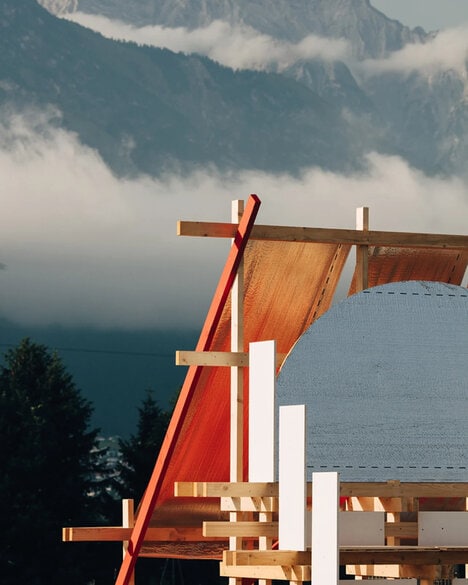
Atelier GABU built ‘Brunebasse’ as a temporary observation tower that opens wide views instead of enclosing them. Created for the 2021 edition of L’Écho du Marteau, the timber structure sits on a hillside in Vaudémont, northeastern France, facing the stone ruins of Brunehaut.
The tower uses slender dimensional lumber in a permeable grid, with select bays wrapped in a semi-transparent textile veil. That fabric filters daylight while keeping sightlines open toward the fields and tree canopy, and the unroofed upper deck gives visitors an elevated lookout over the landscape.
Hand-assembled without mechanical tools, Brunebasse treats low-impact fabrication as part of the design. Atelier GABU shows how a temporary pavilion can act as both viewpoint and frame, using light materials to contrast a heavy historic ruin rather than competing with it.
Image Credit: ©Atelier GABU, designboom, designboom
What Makes This Trend Stand Out
- Permeable Timber Architecture
- Open-grid wood structures introduce lightweight, low-impact spatial experiences that preserve visibility while reducing material intensity in temporary and public design.
- Heritage-framing Installations
- Contemporary pavilions positioned near ruins create new interpretive layers for cultural sites without physically altering historic assets.
- Tool-free Fabrication
- Hand-assembled construction methods highlight opportunities for accessible, reversible building systems suited to remote locations, events, and community-led projects.
Sectors Adopting This
- Architecture
- Temporary lookout structures expand the role of architecture as a minimal intervention that shapes perception rather than enclosing space.
- Tourism
- Scenic installations can transform underused landscapes and heritage destinations into experiential attractions with modest infrastructure requirements.
- Sustainable Construction
- Lightweight timber and textile assemblies demonstrate how circular, low-impact materials can support short-term builds with reduced environmental footprints.