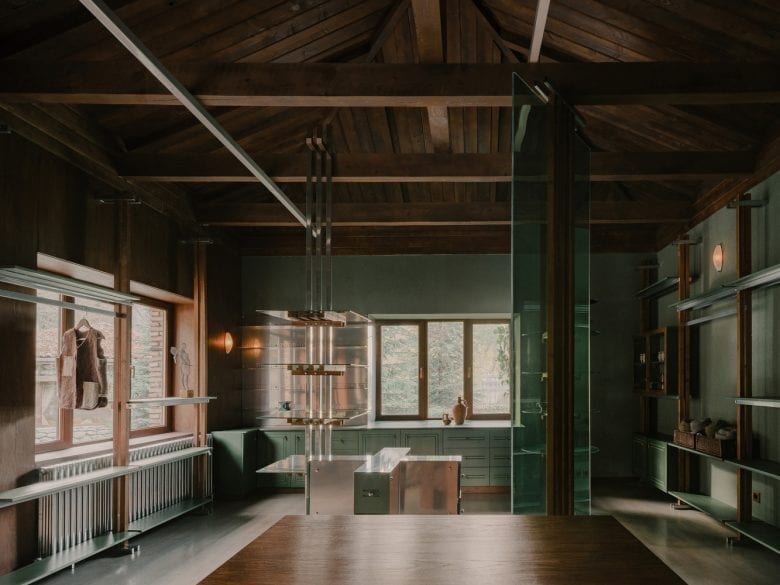
At just 48 square meters, the Lopota Gift Shop in Telavi, Georgia earns its square footage by committing fully to a single design idea. Situated within a hotel complex built around a central lake, the space — designed by Studio Gypsandconcrete — uses the water as its organizing concept rather than its backdrop. Green glass, mirrored on one side, lines the interior to echo the lake's reflective surface and its deep color when viewed from below. Walls finished in greenish-grey stone gravel sit alongside sections of exposed original local stonework, creating a contrast between surfaces that fragments the perceived scale of the room.
Lighting operates in two layers: architectural linear strips that appear to hover below the ceiling, and wall sconces modeled after fishing floats. A two-way mirror positioned at the shop's center reflects inward on one side while remaining transparent on the other, preserving sightlines to the lake. A decorative column pulled from the original structure was repurposed as the leg of the front display table — reassigned from ornament to functional object without losing its character.
What Makes This Trend Stand Out
- Biophilic-reflection Design
- The deliberate integration of natural bodies of water as primary spatial organizers creates new experiences of immersion and place-making within compact retail environments.
- Material-reuse Aesthetics
- Repurposing architectural remnants as functional fixtures fosters layered narratives and distinctive product presentation strategies that juxtapose authenticity with contemporary use.
- Layered-lighting Narratives
- Combining subtle architectural light strips with object-inspired sconces produces nuanced depth and emotive focus that alter perceived scale and customer circulation.
Sectors Adopting This
- Retail Interior Design
- Smaller footprint shops benefit from concept-driven interiors that maximize perceived space and create memorable, brand-defining encounters through reflective surfaces and tactile contrasts.
- Hospitality and Resort Spaces
- Designing retail within resort complexes around local environmental features enables cohesive guest experiences that blur the boundary between accommodation amenities and landscape.
- Sustainable Building Materials
- Local stone, recycled glass, and salvaged architectural elements point toward supply chains and product lines emphasizing provenance, circularity, and material storytelling.