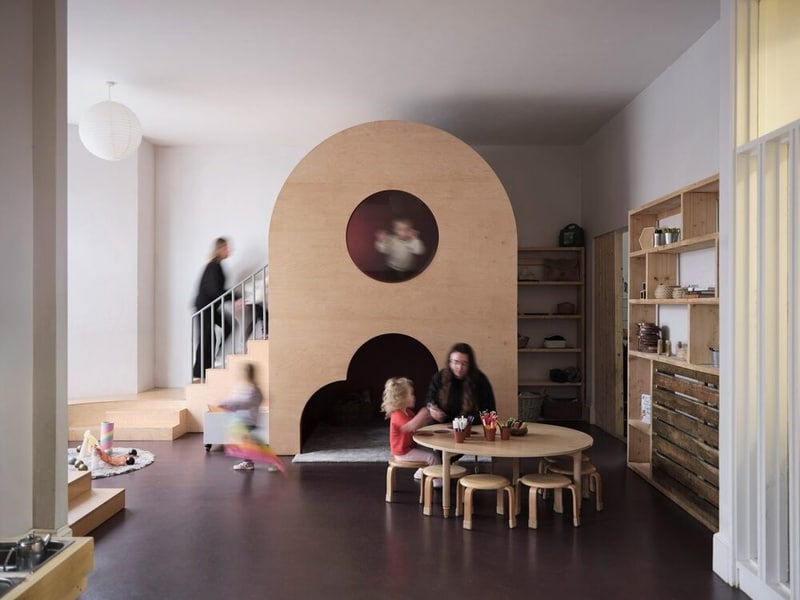
Thing’s the Library conversion transforms a compact interior by introducing a continuous wall of ladders that function as both circulation and storage access. Instead of conventional shelving systems, the design integrates bookshelves into the surrounding architecture, with ladders fixed and movable to allow users to reach different heights. This approach reorganizes the library around vertical movement, turning access into a primary spatial feature rather than a secondary function.
Thing’s design uses the ladder system to define zones within the space without adding partitions, maintaining openness while still structuring how users move and interact with the collection. Shelving is arranged across multiple levels, with ladders acting as connectors between lower and higher storage areas. Materials are kept minimal, emphasizing the contrast between the linear ladder elements and the surrounding surfaces
Image Credit: Rory Gaylor
Why This Trend Is Growing
- Vertical Circulation Design
- Recasting movement as a primary spatial feature opens possibilities for multi-level access systems that redefine compact interiors.
- Integrated Storage-architecture
- Embedding shelving into structural walls creates opportunities for seamless storage that blurs boundaries between furniture and building fabric.
- Ladder-as-spatial-element
- Fixed and movable ladders functioning as connectors and zone markers suggest new modular components that combine circulation and display.
Industries Being Reshaped
- Library Design & Renovation
- Library layouts could prioritize vertical access strategies to increase capacity while maintaining openness and sightlines.
- Retail Store Interiors
- Retail environments may adopt vertical ladder systems to create layered product displays and exploratory customer paths.
- Workspace Architecture
- Workspaces stand to gain flexible, vertical-access storage that emphasizes movement and visual continuity over closed partitions.