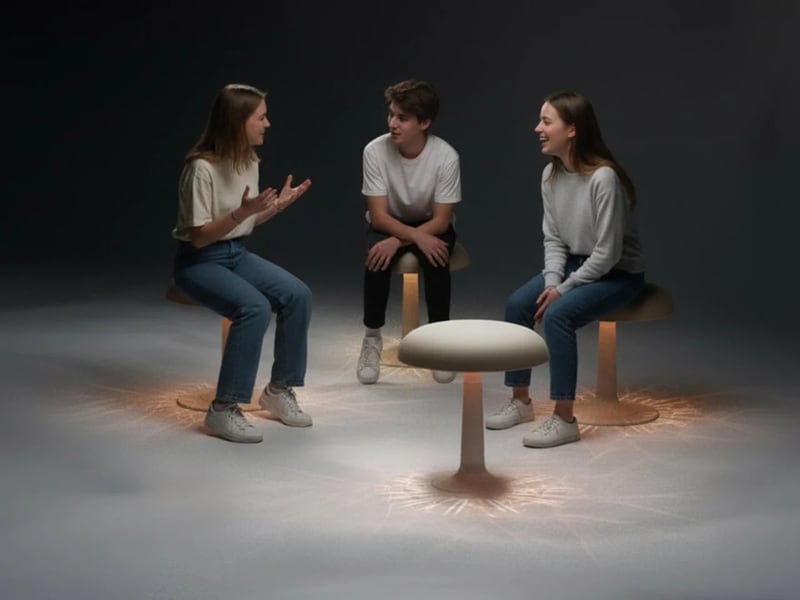
The Spore concept by Bahar Aryana reimagines public seating through an interactive network of illuminated stools inspired by mycelium. Each seat uses integrated pressure and capacitive touch sensors to detect how a person sits, responding with a soft glow that reflects their physical presence. When another nearby stool is occupied, the connected lights synchronize to create a shared visual interaction between users without requiring conversation or direct engagement.
The concept draws on the communication networks found in underground fungal systems to encourage subtle social connection in public spaces. Rather than relying on screens or complex interfaces, Spore uses synchronized lighting as its primary interaction, allowing the installation to respond naturally to changing occupancy. Developed as a student project, the concept explores how interactive furniture could support more engaging and socially connected urban environments.
Image Credit: Bahar Aryana
What Makes This Trend Stand Out
- Responsive Urban Furniture
- Sensor-enabled seating introduces new possibilities for public infrastructure that adapts to occupancy, mood, and social behavior in real time.
- Ambient Social Interfaces
- Soft lighting and non-screen interactions create a subtle layer of communication that can make shared spaces feel more connected without requiring direct conversation.
- Bio-inspired Connectivity
- Mycelium-based design thinking points to decentralized networks of objects that coordinate responses across environments through simple, intuitive signals.
Sectors Adopting This
- Smart Cities
- Connected public seating can expand urban technology beyond utility systems into human-centered environments that improve comfort, engagement, and placemaking.
- Furniture Design
- Interactive materials and embedded sensors open a market for adaptive furniture that functions as both physical infrastructure and experiential technology.
- Public Space Planning
- Data-responsive installations offer planners a new way to understand occupancy patterns while creating more inviting communal areas.