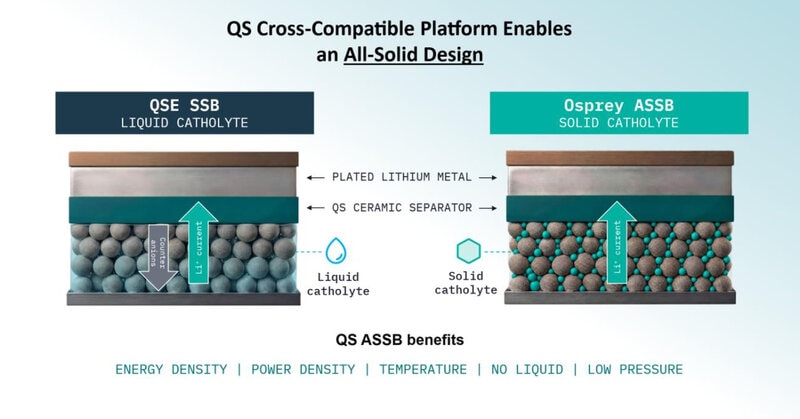
QuantumScape created the ‘Osprey’ cell by replacing the liquid catholyte in its current design with a sulfide solid electrolyte, turning the cathode side fully solid for automakers developing all-solid-state packs. It keeps the ceramic separator and anode-free layout, so lithium metal still forms during the first charge rather than arriving as a separate anode.
In lab testing, a two-layer cell retained about 80% of its capacity after 1,000 full cycles under one atmosphere at 30°C. That pressure level is closer to normal pack conditions than the heavy clamping common in sulfide work. ‘Osprey’ also works as an open platform that can pair with QuantumScape’s own sulfide cathode or customer-developed versions.
While ‘QSE-5’ sample cells come from QuantumScape’s San Jose line, ‘Osprey’ remains at laboratory scale. The open-platform design turns the cell into a B2B pitch for automakers that want sulfide cathodes without bulky pressure hardware.
Image Credit: QuantumScape
Part of the cluster
Retrofit Reserves
Energy backup is being built into sites people already use to prioritize access
Explore the cluster


Why This Trend Is Growing
- All-solid-state Platforms
- Open cell architectures with solid electrolytes on both electrode sides create room for automakers to customize battery chemistry while reducing reliance on bulky pressure systems.
- Anode-free Lithium Metal
- Lithium metal formation during first charge enables higher-density battery designs that simplify material inputs and support next-generation electric vehicle performance.
- Low-pressure Battery Validation
- Testing under pack-realistic pressure conditions highlights pathways for solid-state batteries that are easier to integrate into commercial vehicle platforms.
Industries Being Reshaped
- Electric Vehicles
- Automakers gain new flexibility from solid-state cell platforms that can support longer range, faster charging, and more compact battery pack engineering.
- Battery Manufacturing
- Cell producers can differentiate through modular electrolyte and cathode systems that allow customer-specific configurations without entirely new production architectures.
- Advanced Materials
- Sulfide electrolytes and ceramic separators expand demand for specialized materials that improve conductivity, stability, and scalability in solid-state energy storage.