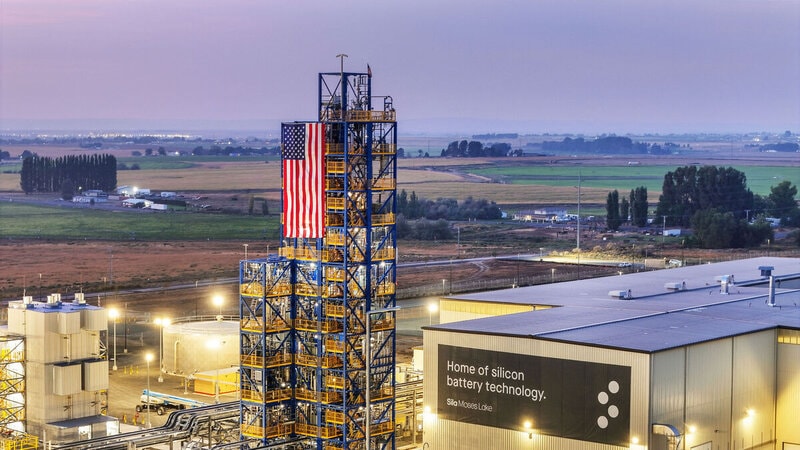
Sila announced a $1.4 billion loan from the U.S. Department of Defense to expand production of its silicon-carbon anode material at its Moses Lake, Washington, factory. The material is designed to offer higher energy density than conventional graphite anodes, supporting longer-lasting or lighter batteries.
The Moses Lake facility began operating in September and currently produces about 2 GWh of anode material annually. Sila plans to expand the plant roughly fivefold, creating enough capacity to supply batteries for more than 100,000 EVs. The company also raised $300 million in July and has existing commercial agreements with Mercedes and Panasonic.
For defense and mobility customers, silicon-carbon anodes could support higher-performance batteries for applications such as drones and electric vehicles. The Pentagon financing also reflects growing U.S. efforts to strengthen domestic battery-material supply chains and reduce dependence on China-dominated graphite production.
Image Credit: Sila
Key Themes Behind This Trend
- Domestic Battery Materials
- Pentagon-backed financing signals a growing market for localized battery inputs that reduce reliance on overseas graphite supply chains.
- Silicon-carbon Energy Density
- Higher-capacity anode chemistry creates room for lighter EVs, longer-range drones, and performance-focused portable power systems.
- Defense-driven Cleantech Scaling
- Military demand is accelerating commercialization pathways for advanced energy technologies that can serve both security and civilian mobility markets.
Where This Applies
- Electric Vehicles
- Automakers gain access to next-generation battery materials that can extend driving range while supporting lighter vehicle architectures.
- Aerospace and Defense
- Battery improvements for drones and field systems open new possibilities for endurance, payload flexibility, and electrified mission platforms.
- Battery Manufacturing
- Expanded anode production capacity reshapes supplier dynamics as manufacturers seek differentiated chemistries beyond conventional graphite.