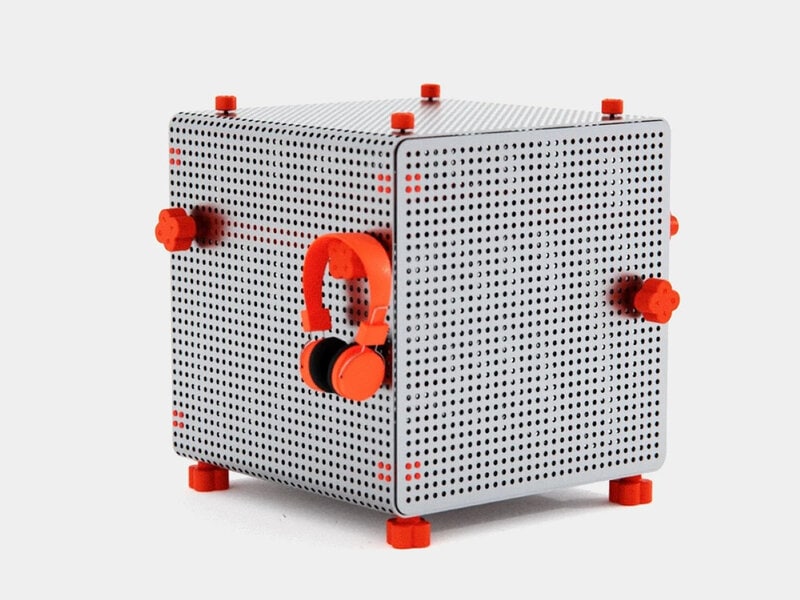
Liam de la Bedoyere's Holy Moly Cabinet turns flat-pack furniture hardware into one clover-shaped orange connector. Depending on where it's mounted, the fitting works as a door pull, leg, hinge, or shelf bracket.
The connector splits into two snap-together halves: the cap reads HOLY, and the stem reads MOLY. The cabinet itself uses perforated steel panels so that the same part can thread into different holes for shelves, feet, or doors.
That setup keeps the furniture adjustable after assembly, since shelves can move without new drilling and worn parts can be swapped with the same hardware. It also lets the cabinet stack into a taller unit with the same connectors at the seam. By turning the body into a mounting surface, the design makes storage feel more flexible and repair-friendly.
Image Credit: Yanko Design - Modern Industrial Design News
Why This Trend Is Growing
- Multi-use Furniture Connectors
- Single hardware components that perform multiple roles introduce modularity that can reduce part complexity, streamline repairs, and extend product lifecycles.
- Perforated Assembly Platforms
- Grid-based furniture surfaces create flexible mounting ecosystems where shelves, doors, legs, and accessories can be repositioned without permanent modification.
- Repair-friendly Flat-pack Design
- Standardized replaceable fittings support longer-lasting furniture models that align with circular design principles and reduce dependence on full-unit replacement.
Industries Being Reshaped
- Furniture Manufacturing
- Modular connector systems point to new product architectures where fewer parts enable customizable, serviceable, and scalable home storage solutions.
- Interior Design
- Adaptable flat-pack formats expand opportunities for spaces that can evolve over time through reconfiguration rather than renovation or new purchases.
- Sustainable Consumer Goods
- Durable products built around interchangeable components reflect growing potential for circular business models centered on repair, reuse, and material efficiency.