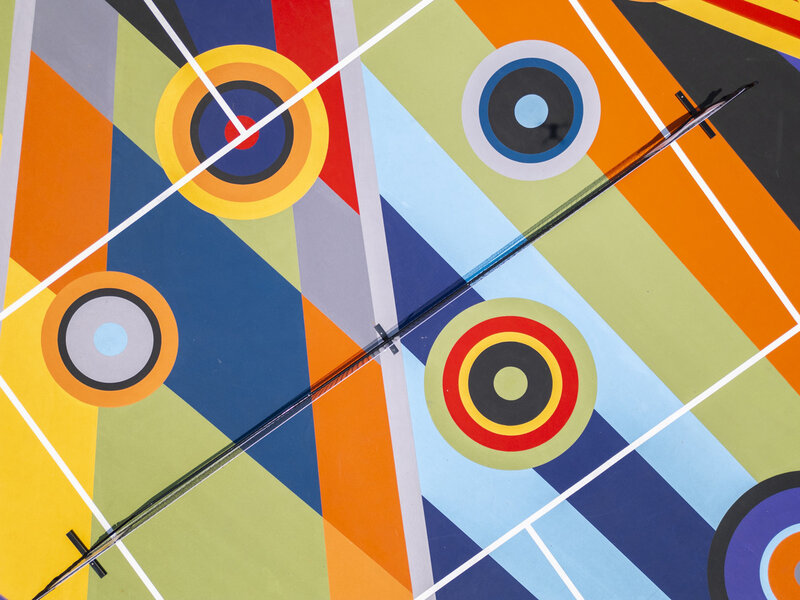
Geometry of Play is a public art installation by Sharmistha Ray that transforms two pickleball courts at Pittsburgh's Arts Landing into a fully playable geometric mural. Inspired by historic board games such as Pachisi, the large-scale composition layers circles, triangles, grids, and pathways across the court using the full ROYGBIV color spectrum. As Pittsburgh's first artist-designed pickleball courts, the installation combines recreation and public art, allowing player movement to become an active part of the visual composition.
Commissioned by the Pittsburgh Cultural Trust, the installation is one of eight inaugural public artworks at the new Arts Landing civic space, designed by Field Operations. The project reflects Ray's interdisciplinary practice, drawing on geometric abstraction and South Asian visual traditions while exploring themes of identity, inclusion, and cultural exchange.
Image Credit: Ross Ribblett
Key Themes Behind This Trend
- Playable Public Art
- Recreation spaces are evolving into participatory cultural landmarks where everyday movement adds value to civic storytelling and spatial engagement.
- Artist-designed Sports Courts
- Sports infrastructure is becoming a canvas for visual identity, creating opportunities for municipalities and brands to merge wellness, design, and placemaking.
- Culturally Rooted Geometry
- Geometric abstraction informed by heritage traditions offers new ways to embed inclusion, identity, and cultural exchange into shared urban environments.
Where This Applies
- Public Art
- Large-scale interactive commissions are expanding the role of public art from passive viewing to immersive participation across civic spaces.
- Recreation
- Community sport venues can differentiate through aesthetic experiences that make casual play more social, memorable, and destination-worthy.
- Urban Planning
- Civic developments are integrating art, leisure, and cultural programming to create multifunctional public spaces with stronger community relevance.