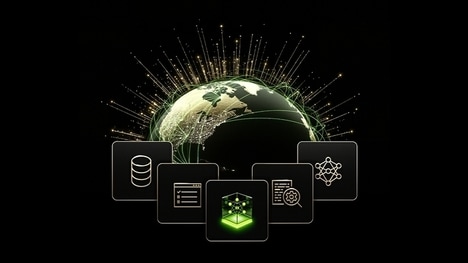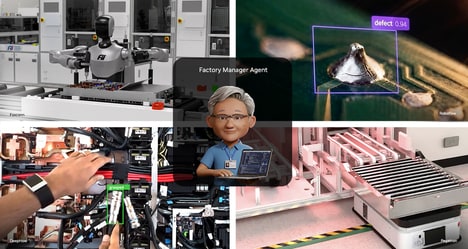

Nvidia launched a suite of physical AI research tools, agent workflows and open-source models that build on its Cosmos 3 world foundation model, designed to accelerate development of robots, autonomous vehicles and vision-based AI systems. Announced at the Computer Vision and Pattern Recognition (CVPR) conference, the release includes integrated agent skills across Omniverse, Isaac Sim, Isaac Lab and Cosmos, featuring automated scene reconstruction, simulation setup and synthetic data generation.
The company also introduced Alpamayo 2 Super, a 32-billion-parameter vision-language-action model for autonomous driving, designed with advanced reasoning capabilities to operate across the driving stack. Additional updates to Nvidia’s Metropolis platform add video search, summarization and synthetic data generation tools, while new capabilities help researchers reconstruct real-world environments from fleet data and generate rare edge-case scenarios for vehicle testing.
For developers, the new tools streamline simulation, policy training and evaluation workflows while reducing the manual effort required to build and manage virtual environments. By bringing key stages of physical AI development into a more unified workflow, Nvidia aims to help teams train, validate and deploy real-world AI systems more efficiently and safely.
Image Credit: Nvidia Cosmos 3
Key Themes Behind This Trend
- Physical AI Workflows
- Unified agent toolkits are compressing the path from simulated environments to real-world robotics, creating room for faster validation of autonomous systems across industrial and mobility settings.
- Synthetic Edge-case Training
- Rare scenario generation is emerging as a critical layer for safer AI testing, expanding the value of simulated data in markets where real-world failures are costly or difficult to capture.
- Vision-language-action Models
- Advanced multimodal models are shifting autonomous systems toward reasoning-based control, opening new possibilities for machines that interpret visual context and execute complex physical tasks.
Where This Applies
- Robotics
- Robot development is being reshaped by integrated simulation, reconstruction and policy training tools that reduce manual environment-building and improve deployment readiness.
- Autonomous Vehicles
- Self-driving platforms benefit from foundation models and synthetic scenario testing that strengthen perception, planning and safety validation across the driving stack.
- Computer Vision
- Video search, summarization and scene reconstruction capabilities are expanding computer vision from passive analysis into a foundation for interactive physical AI systems.