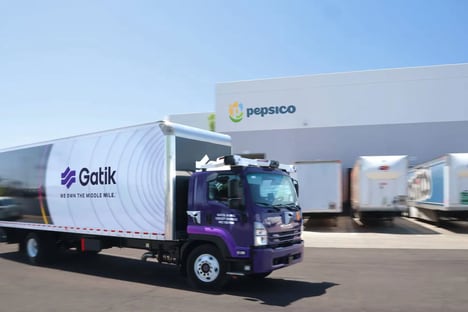
Gatik is scaling autonomous freight operations with $200 million in Series D financing led by Qatar Investment Authority and Koch Disruptive Technologies. The company operates AI-powered driverless trucks across high-frequency regional routes connecting distribution centers and stores for retail, grocery, and CPG supply chains. Gatik has completed 85,000 fully driverless orders, achieved 99% on-time delivery, and secured more than $600 million in contracted revenue.
The funding will help Gatik expand from dozens of autonomous trucks operating across North America to thousands in the coming years. Its focus on repeatable regional routes offers retailers a way to add transportation capacity while maintaining predictable delivery schedules and responding dynamically to changing demand. As autonomous trucking moves toward broader commercial deployment, Gatik's existing customer contracts and operating record could help it capture growing logistics spending while enabling major companies to reduce reliance on conventional freight capacity.
Image Credit: Gatik
What Makes This Trend Stand Out
- Autonomous Middle-mile Freight
- Repeatable regional routes create a focused entry point for driverless trucking systems that improve capacity, reliability, and cost control in retail distribution networks.
- AI-powered Delivery Operations
- Machine learning-enabled fleet management is reshaping freight planning by supporting dynamic routing, predictable schedules, and high-volume driverless order fulfillment.
- Contracted Robotics Scale-ups
- Large contracted revenue pipelines are giving autonomous logistics providers a stronger commercialization path as enterprise customers seek proven operational performance before broad deployment.
Sectors Adopting This
- Retail Logistics
- Retailers are positioned to benefit from autonomous freight networks that connect distribution centers and stores with more consistent replenishment and reduced exposure to driver shortages.
- Grocery Supply Chain
- Time-sensitive grocery distribution presents a strong use case for driverless regional transport because delivery precision and frequent store restocking are central to operational efficiency.
- Commercial Trucking
- Traditional freight carriers face emerging competition from autonomous fleet operators that can scale dedicated routes and shift the economics of short-haul transportation.