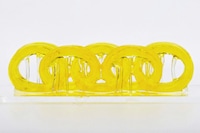
Now that additive manufacturing is being used as a groundbreaking technology in the automotive, furniture, fashion, medical industres and beyond, 3D printing filaments are becoming super specialized.
3D Systems just released its Infinity Rinse-Away filament, which is water soluble so that it can be used as a temporary support structure for 3D prints that are complex or feature moving parts. Typically, removing support structures from 3D printing requires careful maneuvering or a chemical bath, but because this new filament is made from a biodegradable material, the removal process has the potential to become quicker and easier.
Other noteworthy 3D printing filaments include ones that are made from fully recycled materials, food waste, as well as ones that are highly sustainable or worthy of being used in outer space.
What Makes This Trend Stand Out
- Specialized 3D Printing Filaments
- The development of specialized 3D printing filaments, such as water soluble or recycled material filaments, presents disruptive innovation opportunities in additive manufacturing.
- Biodegradable Filaments
- The introduction of biodegradable 3D printing filaments, like 3D Systems' Infinity Rinse-Away filament, offers the potential for quicker and easier removal of support structures, revolutionizing the 3D printing process.
- Sustainable Filaments
- The emergence of sustainable 3D printing filaments, including those made from food waste or materials suitable for space exploration, opens up new possibilities for environmentally friendly manufacturing.
Sectors Adopting This
- Automotive Industry
- The automotive industry can leverage specialized 3D printing filaments to create complex or moving parts, enhancing production efficiency and design possibilities.
- Furniture Industry
- The furniture industry can benefit from the use of biodegradable filaments, as they can simplify the removal of support structures and enable the creation of intricate and unique designs.
- Medical Industry
- The medical industry can explore the use of sustainable filaments, such as those made from food waste, to promote eco-friendly practices in the production of medical devices and implants.