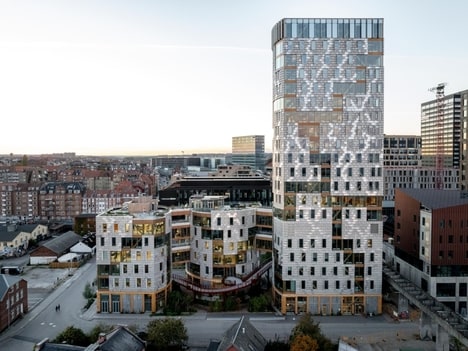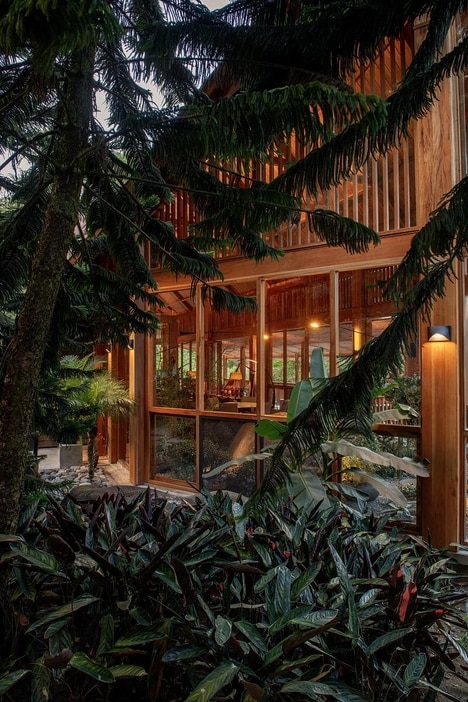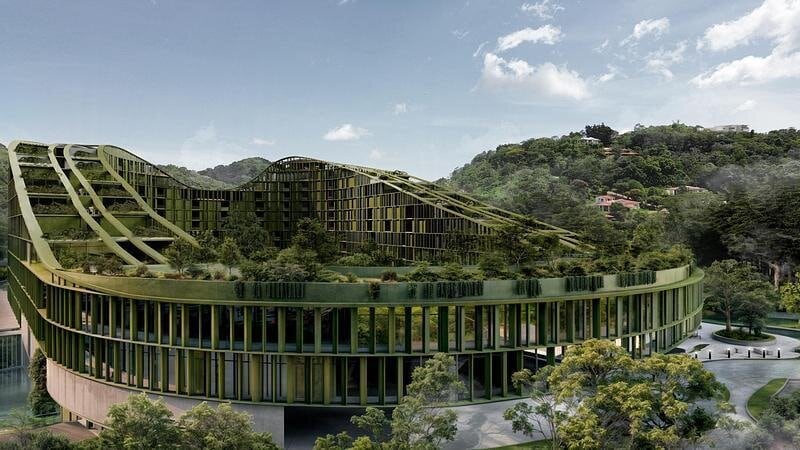
Costa Rica-based practice Carazo Arquitectura has designed a vertical neighborhood called LTR1. This 60,265-square-meter mixed-use development is located in Nuevo Cuscatlán, El Salvador. The concept was recently awarded both Jury Winner and Popular Choice Winner honors at the Architizer A+Awards in the Unbuilt Multi-Unit Housing category.
Carazo Arquitectura's LTR1 proposes a hybrid building that integrates over 400 middle-income residential units with retail, gastronomy, coworking spaces, wellness facilities, and public areas into a continuous vertical and horizontal neighborhood. The design was fundamentally shaped by an existing forest at the center of the site, with the building bending into an oval configuration around the trees to preserve ecological continuity. The roofline, on the other hand, was derived from geometric translations of the surrounding mountain profiles, including El Picacho and the San Salvador volcano.
Image Credit: Carazo Arquitectura
What Makes This Trend Stand Out
- Forest-centered Housing
- Residential developments organized around preserved ecosystems signal new potential for real estate models that treat biodiversity as a core amenity rather than a site constraint.
- Vertical Mixed-use Neighborhoods
- Dense buildings combining homes, retail, coworking, wellness, and public space reflect rising demand for self-contained communities that reduce dependence on car-based urban routines.
- Landscape-inspired Architecture
- Architectural forms shaped by mountains, forests, and local terrain create differentiated placemaking opportunities that merge cultural identity with climate-sensitive design.
Sectors Adopting This
- Residential Real Estate
- Middle-income housing projects can gain market distinction through integrated amenities and ecological preservation that expand the value proposition beyond unit count and location.
- Urban Planning
- Compact neighborhood frameworks that blend vertical density with public access offer alternative growth strategies for cities facing land scarcity and environmental protection pressures.
- Sustainable Architecture
- Design practices that preserve existing natural assets while accommodating large-scale mixed-use programs point to scalable approaches for lower-impact urban development.