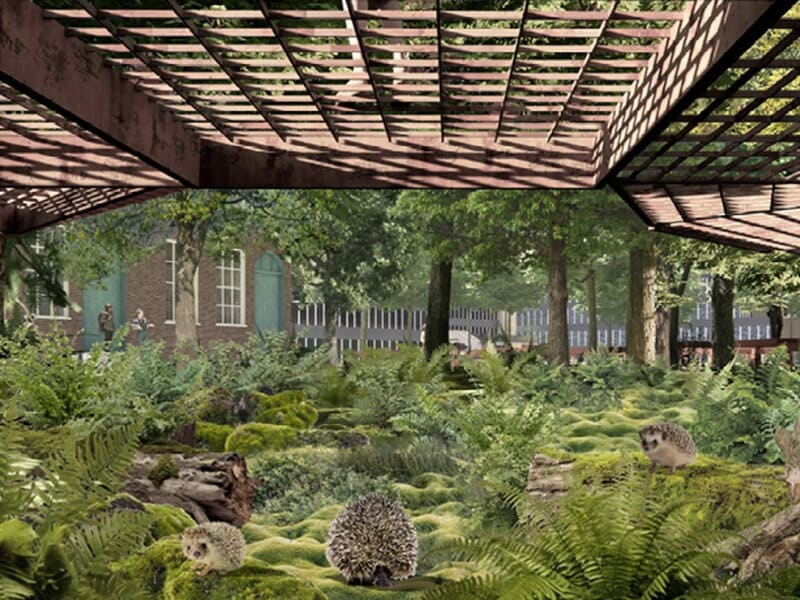
Urban Living Library is a landscape masterplan by Fengyi Wu that transforms the UCL Bloomsbury Campus into an interconnected habitat supporting urban biodiversity. Developed as a research thesis at The Bartlett School of Architecture, the proposal uses the hedgehog as a flagship species to guide spatial planning and ecological restoration. Dense planting, wildlife shelters, rainwater landscapes and community gathering spaces are arranged to create continuous green corridors that support animal movement while integrating biodiversity into everyday campus life.
The proposal positions landscape as an educational resource by encouraging observation of natural systems through accessible outdoor environments. Habitat connectivity, stormwater management and planting strategies work together to strengthen ecological resilience while supporting shared use by people and wildlife. The project received First Prize at the IFLA Europe 2025 Student and Young Professionals Awards, recognizing its approach to campus-scale ecological design.
Image Credit: Fengyi Wu
Key Themes Behind This Trend
- Campus Biodiversity Networks
- Interconnected green corridors across academic properties present new models for blending habitat restoration with student life, research visibility and climate resilience.
- Flagship Species Planning
- Using recognizable animals as spatial planning guides creates opportunities for emotionally engaging ecological design that makes biodiversity strategies easier to understand and measure.
- Living Landscape Education
- Outdoor environments designed as teaching tools can turn campuses into open-air laboratories where sustainability, public space and environmental literacy converge.
Where This Applies
- Higher Education
- Universities can differentiate campus development through biodiversity-centered masterplans that support wellness, research, recruitment and long-term sustainability commitments.
- Landscape Architecture
- Ecological connectivity frameworks are expanding the role of landscape designers from beautification toward resilience planning, habitat engineering and multispecies urban systems.
- Urban Planning
- City-scale adoption of wildlife-friendly campus and district design suggests new pathways for integrating stormwater infrastructure, public gathering areas and biodiversity corridors.