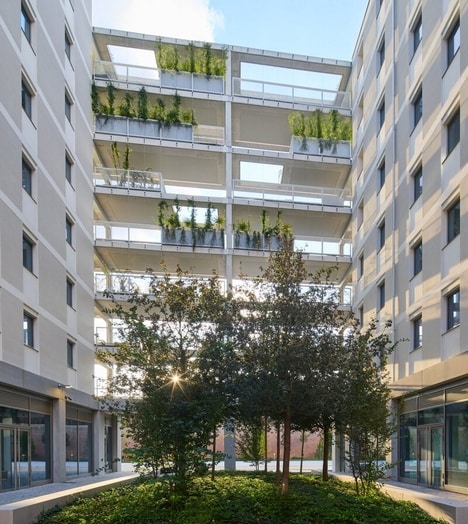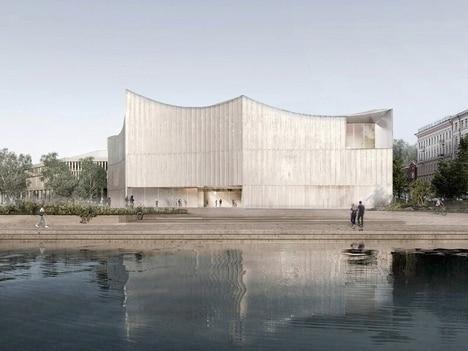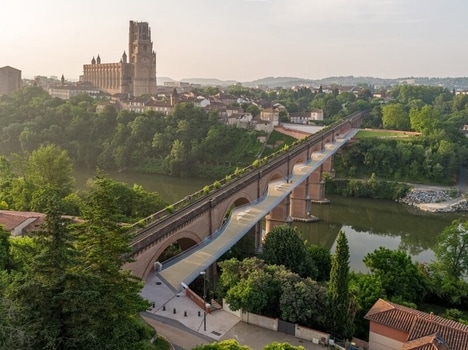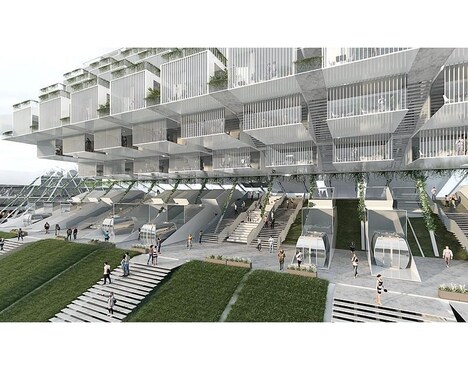
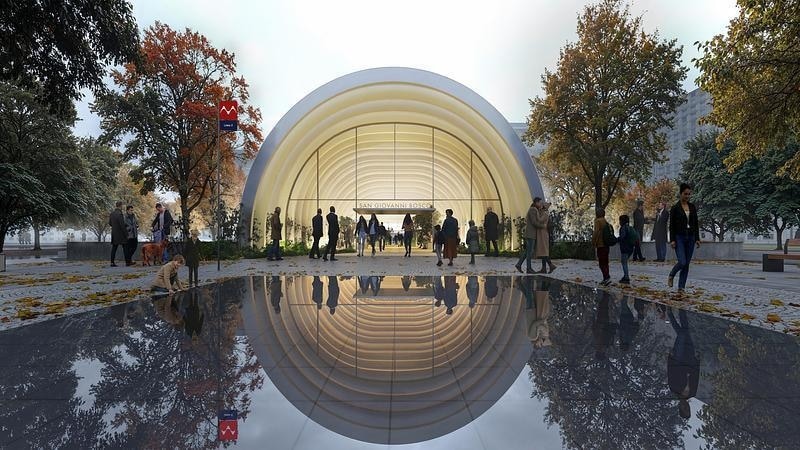
UNS, in collaboration with Settanta7, Mijksenaar, Frigorosso, 3BA, and WSP, has won the international competition to design Turin’s Metro Line 2. The selected proposal is called 'Beneath The Porticoes', and it reimagines the subway as a civic landmark that strengthens the connection between mobility, public space, and the city’s historic urban fabric.
The winning design draws directly from Turin’s 18 kilometres of arcaded porticoes and its rivers, as the architectural team interprets the metro line as a new "urban river" that connects neighbourhoods, histories, and generations through a modular architectural language of arches, curves, and squares that transition from restrained exteriors to warmer, more detailed interiors.
The 'Beneath The Porticoes' project also includes a three-level identity system — Network, System, and Station — ensuring that a passenger can easily recognize an entrance from the street, navigate the platform without confusion, and remember which stop is which thanks to local art, landscape elements, and thematic principles.
Image Credit: Produced by HISM, ©Extraordinary Commissioner Chiaia
What Makes This Trend Stand Out
- Civic Landmark Transit Design
- Transit stations increasingly function as civic landmarks that merge mobility with cultural identity and activate public space in ways that alter urban perception of transport infrastructure.
- Modular Architectural Language
- Modular arches, curves, and interior typologies enable scalable, repeatable station designs that can be locally customized to compress delivery timelines and reduce cost variability.
- Three-level Wayfinding Systems
- Layered identity systems of Network, System, and Station create intuitive navigation hierarchies that significantly lower passenger cognitive load and improve accessibility across diverse user groups.
Sectors Adopting This
- Urban Transit Authorities
- Public transport agencies stand to reposition networks as place-making platforms that shift rider expectations toward experiential, destination-driven travel rather than mere point-to-point conveyance.
- Architecture and Urban Design Firms
- Design practices can capitalize on heritage-informed modular solutions to offer repeatable yet site-specific proposals that streamline procurement and enhance competitiveness in civic commissions.
- Public Art and Landscape
- Art and landscape specialists are positioned to embed local narratives into stations, converting transit nodes into cultural assets that expand funding sources through tourism and community partnerships.