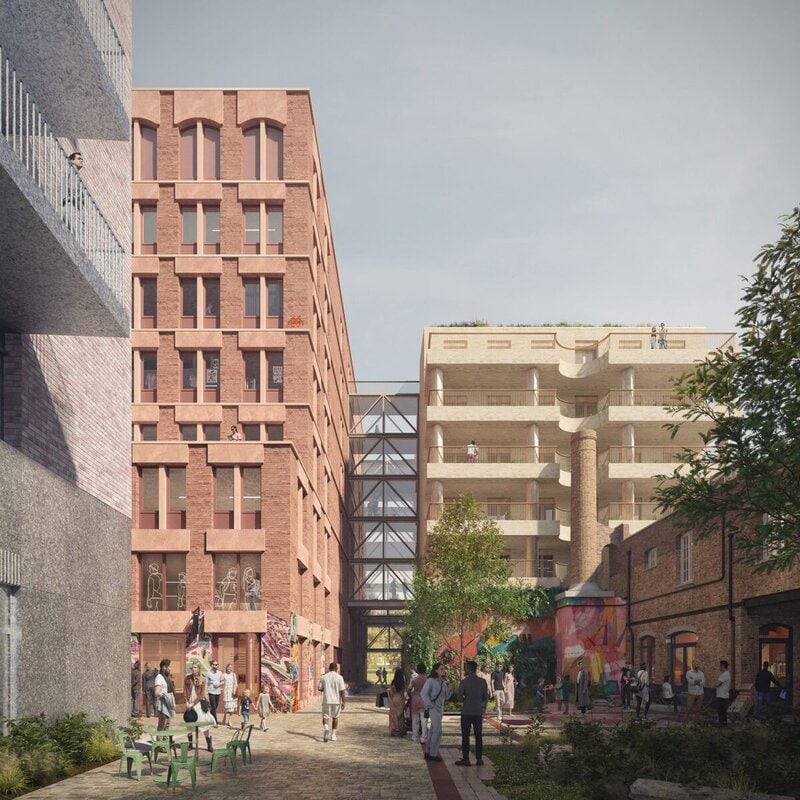
The Truman Brewery masterplan by Buckley Gray Yeoman has been approved for three sites near Brick Lane in east London. The mixed-use development comprises eight buildings designed by Buckley Gray Yeoman alongside Carmody Groarke, Morris+Company, and Henley Halebrown. Plans include 35,000 square metres of office, retail, and community space, a 5,200-square-metre data centre by Morris+Company, and the redevelopment of the Grade II-listed Boiler House with a two-storey extension and new public space.
The development also includes 44 homes, six of which are designated as social housing for larger Bangladeshi-heritage families. Arranged around a series of courtyards, the scheme retains the Truman Brewery chimney as a prominent landmark within the site. The proposal received approval from the Ministry of Housing, Communities and Local Government despite opposition from Tower Hamlets Council and the Save Brick Lane campaign group, which raised concerns over housing provision and the potential impact on the surrounding community.
Image Credit: Conica Studio
Why This Trend Is Growing
- Heritage-led Mixed-use Districts
- Historic industrial sites are becoming platforms for dense urban programs that combine workspaces, housing, retail, and civic amenities while preserving recognizable local landmarks.
- Urban Data Centre Integration
- Embedding data infrastructure within city masterplans signals new possibilities for colocating digital capacity with commercial, residential, and community uses.
- Culturally Responsive Housing
- Family-sized social homes tailored to specific community needs reflect a growing shift toward more inclusive residential planning in contested urban neighborhoods.
Industries Being Reshaped
- Commercial Real Estate
- Large-scale mixed-use approvals highlight emerging value in developments that blend offices, retail, housing, public space, and infrastructure within heritage settings.
- Urban Planning
- Community opposition and government approval processes reveal a changing landscape where density, preservation, affordability, and local identity increasingly shape redevelopment strategies.
- Data Infrastructure
- Purpose-built data centres within regeneration schemes point to expanding demand for discreet, urban digital facilities that serve nearby businesses and connected services.