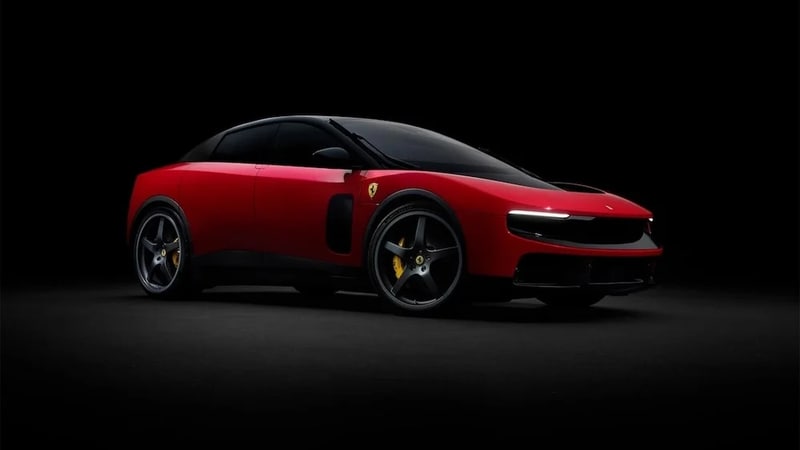
Ferrari unveiled the Luce as the company’s first fully electric vehicle developed in collaboration with Jony Ive, Marc Newson, and the San Francisco-based design collective LoveFrom. The five-seat EV combines smooth body surfacing, flush glazing, enclosed wheel designs, and simplified geometric forms across a low-profile grand touring silhouette. Ferrari paired the exterior with a glass-heavy cabin featuring anodized aluminum, OLED display systems, and a rotating central screen integrated into the dashboard architecture.
The interior incorporates physical switches, dials, and levers alongside digital interfaces, departing from touchscreen-dominant EV layouts. Ferrari and LoveFrom developed a movable instrument cluster, a multifunction mechanical display system, and a gear selector integrating Gorilla Glass components throughout the cockpit. The Luce uses a four-motor electric drivetrain producing more than 1,000 horsepower with a reported 0–60 mph time below 2.5 seconds and an estimated driving range exceeding 300 miles.
Image Credit: Ferrari
Why This Trend Is Growing
- Designer-driven EV Aesthetics
- A shift toward collaborations with high-profile designers creates demand for signature exterior and cabin languages that redefine brand differentiation in electric vehicles.
- Hybrid Analog-digital Cockpits
- Combining tactile controls with expansive OLED and rotating displays introduces new paradigms for driver engagement and user-interface personalization in premium cars.
- High-performance Multi-motor Drivetrains
- Ultra-fast, quad-motor architectures delivering supercar acceleration and long-range capability reshape expectations for performance, packaging, and thermal management in EV platforms.
Industries Being Reshaped
- Luxury Automotive
- The premium segment is positioned to leverage designer collaborations and bespoke material palettes to command higher margins and cultivate exclusive customer experiences.
- Automotive Interior Materials
- Innovations in anodized metals, Gorilla Glass integration, and seamless glazing open possibilities for new supply chains and manufacturing techniques focused on premium tactile quality.
- Battery and Power Electronics
- Advances in energy density and high-power electronics become critical to supporting multi-motor setups that aim to balance extreme performance with long driving ranges.