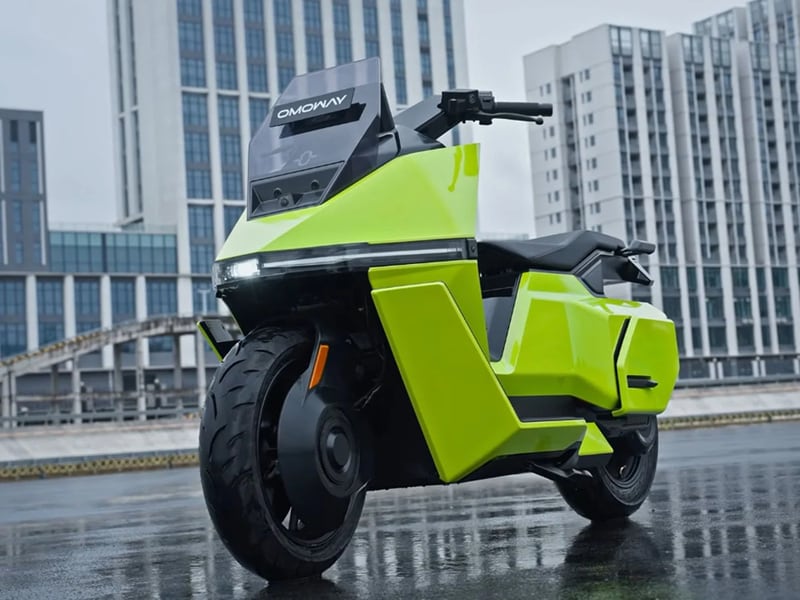
The OMO X by OMOWAY is a self-balancing electric scooter that integrates AI systems with gyroscopic stabilization to maintain balance at low speeds and when stationary. Developed using the brand’s OMO-ROBOT architecture, the vehicle combines sensors, cameras, and onboard processors to continuously monitor its surroundings and adjust positioning in real time. A Control Moment Gyroscope system enables the scooter to remain upright without a kickstand, applying aerospace-derived stabilization technology to urban mobility.
The scooter includes a modular design that allows it to shift between step-through, street, and touring configurations through interchangeable components. Additional features include adaptive cruise control, autonomous parking, and a summon function that enables the scooter to move independently toward the rider. The model reaches speeds of approximately 110 km/h with a projected range of around 200 kilometres, supported by a digital interface, wireless charging capability, and integrated safety systems.
Image Credit: OMOWAY
Why This Trend Is Growing
- AI-stabilized Micromobility
- The integration of onboard AI with gyroscopic stabilization creates potential for new classes of low-speed personal vehicles that significantly reduce tipping risk and enable confident urban use.
- Modular Vehicle Platforms
- Interchangeable step-through, street, and touring configurations point toward platform-centric product families that could upend traditional single-purpose scooter design and aftermarket revenue streams.
- Autonomous Last-meter Mobility
- Features like summon functions and autonomous parking suggest emergence of autonomous last-meter services that can bridge gaps between mass transit, delivery endpoints, and personal mobility.
Industries Being Reshaped
- Micromobility Manufacturing
- Manufacturers can be disrupted by shifting demand toward sensor-rich, software-defined scooters that combine mechanical design with continuous OTA updates and AI-driven features.
- Aerospace Stabilization Systems
- Aerospace-derived control moment gyroscopes and stabilization expertise present opportunities for cross-industry licensing and scaled-down inertial systems for consumer vehicles.
- Fleet Management and Mobility Services
- Shared mobility operators and fleet managers may face transformation as autonomous parking, wireless charging, and remote summon capabilities enable denser, lower-cost urban fleets and new service models.