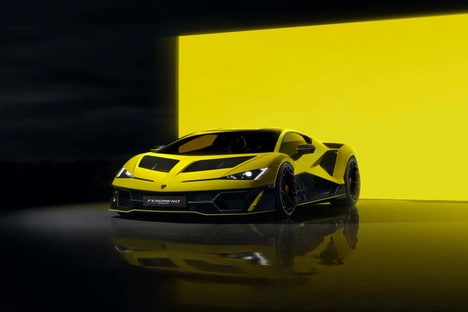
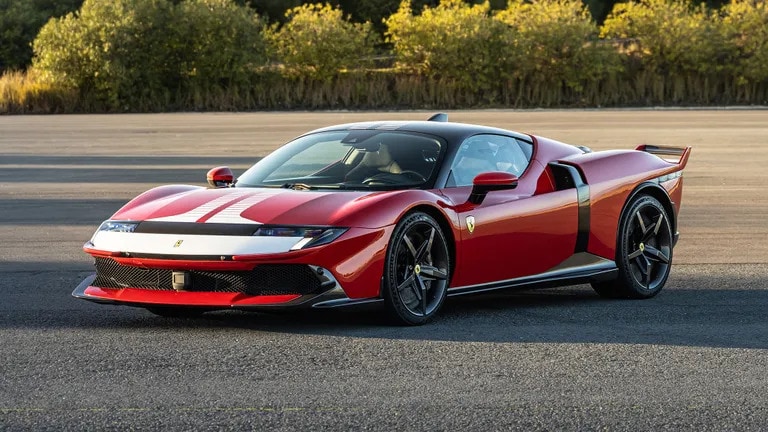
The 2027 Ferrari 849 Testarossa is a mid-engine, plug-in hybrid supercar from Ferrari featuring a new vehicle-estimation system called FIVE, designed to model the car’s behavior in real time to coordinate brakes, torque vectoring and hybrid AWD. The 849 pairs a 4.0L twin-turbo V-8 with three e-motors for a combined 1,035 hp and a 7.9-kWh battery that enables short pure-electric driving, with claimed 0–60 mph performance around 2.0 seconds.
Ferrari revised the powertrain, turbos, cooling and suspension hardware to shave weight and boost responsiveness, and fitted enhanced aero including cascading vortex generators and an active rear spoiler. The cabin gains a configurable dash, new steering-wheel controls and optional Assetto Fiorano trim, which reduces mass and increases downforce for track-focused buyers.
For drivers, FIVE promises more predictable high-speed handling by pre-loading dynamic systems to suit conditions, letting owners exploit extreme power with confidence and aligning with a broader trend toward AI-linked vehicle controls that enhance safety without sacrificing performance.
Image Credit: Ferrari
What Makes This Trend Stand Out
- AI-linked Vehicle Controls
- Real-time AI modeling of vehicle behavior is enabling coordinated actuation of brakes, torque vectoring and AWD to deliver predictable high-speed handling under extreme performance conditions.
- Hybrid Performance Electrification
- Combining high-output combustion engines with multiple e-motors and a small battery pack is creating architectures that prioritize instantaneous torque and track-capable electric assist without long-range EV compromises.
- Predictive Dynamics Coordination
- Pre-loading dynamic systems based on estimated future vehicle states is allowing control systems to harmonize aero, suspension and powertrain responses for optimized lap-time stability.
Sectors Adopting This
- Automotive Original Equipment Manufacturers
- Luxury and sports OEMs stand to redefine performance vehicle segments by integrating machine-estimation systems that balance raw power with driver confidence and regulatory safety demands.
- Performance Parts and Aerodynamics
- Active aero, cascading vortex generation and lightweight track-focused trims are driving new component markets that blend aerodynamic efficiency with adaptive mechanical control.
- Vehicle Software and Simulation
- Real-time vehicle estimation and control software is emerging as a core platform, enabling predictive coordination across braking, torque distribution and hybrid systems for scalable performance solutions.