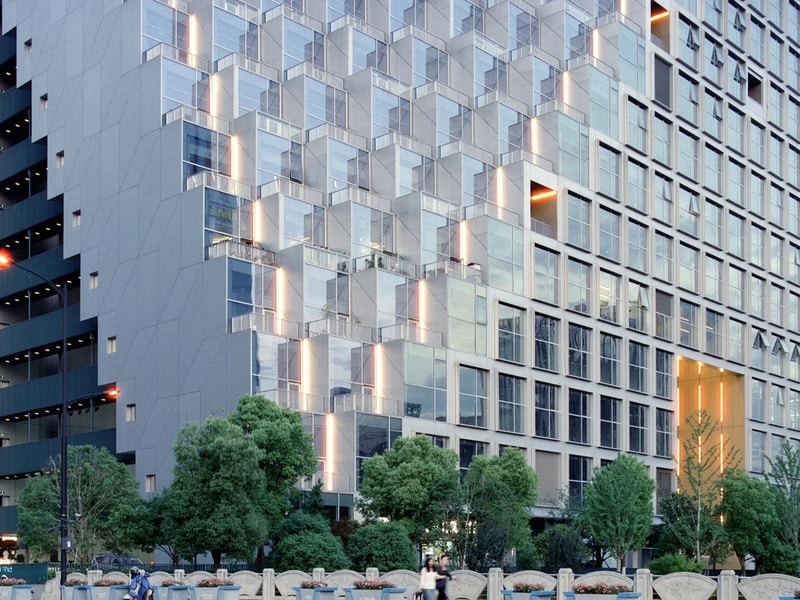
The Hangzhou Prism is a 43,000-square-metre mixed-use building designed by OMA for Xinhu Real Estate Group in Hangzhou’s Future Tech City district. Led by OMA partner Chris van Duijn and project architect Michael Hadjistyllis, the project rethinks the conventional tower by consolidating residential, hospitality, office, and retail programs within a single sculptural volume.
Rising 106.5 metres, the building is defined by two large oblique cuts that carve through the structure, creating cascading terraces and angular facades lined with projecting cubic balconies. The design was conceived as a "three-dimensional village" for young professionals and visitors.
The development includes a 20,000-square-metre hotel, 10,000 square metres of residential space, 5,000 square metres of offices, and 8,000 square metres of retail. At street level, a large public atrium opens the building toward an adjacent park, creating a gathering space designed for events and everyday use.
Image Credit: OMA
Key Themes Behind This Trend
- Vertical Mixed-use Villages
- Dense urban developments are merging housing, hospitality, offices, and retail into single landmark structures that support continuous daily activity and reduce dependence on single-purpose districts.
- Terraced Urban Architecture
- Cascading balconies, carved facades, and elevated outdoor spaces introduce new models for high-rise living that blend private amenity, public visibility, and biophilic design.
- Public Atrium Placemaking
- Ground-level atriums connected to parks and streets are transforming towers into civic destinations where events, retail, and informal gathering spaces increase building value.
Where This Applies
- Commercial Real Estate
- Integrated towers with multiple revenue-generating uses create more resilient asset models for developers navigating changing demand across office, residential, hotel, and retail markets.
- Architecture and Design
- Sculptural high-rise forms are expanding the role of architects in shaping hybrid urban experiences that differentiate properties through spatial complexity and experiential identity.
- Hospitality
- Hotels embedded within mixed-use developments gain access to built-in residential, business, retail, and cultural ecosystems that broaden guest engagement beyond conventional lodging.