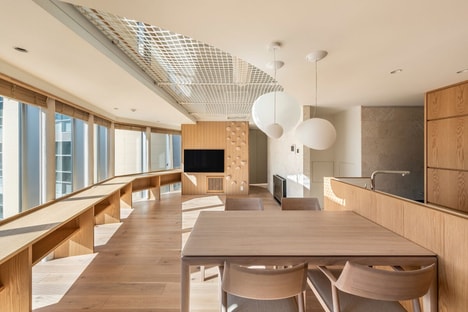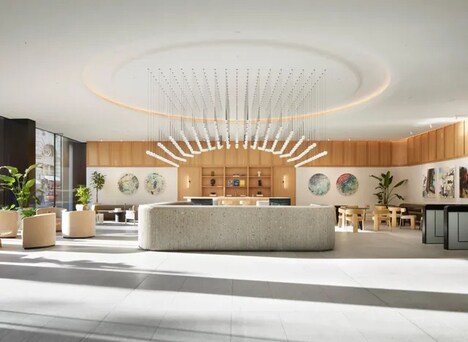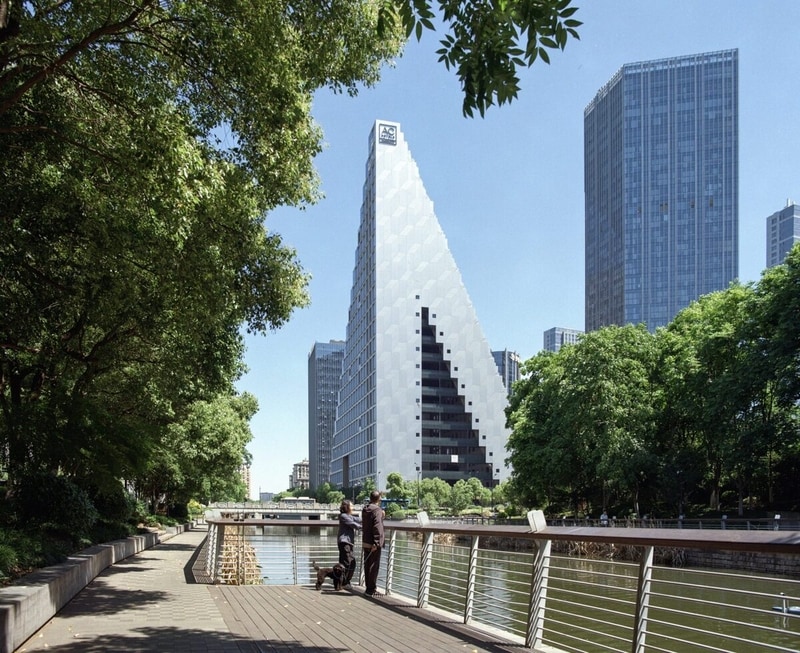
The Hangzhou Prism is a mixed-use development designed by OMA in Hangzhou, China. Hangzhou Prism contains 43,000 square metres of space and rises to a height of 106.5 metres. The building combines a hotel, residential units, offices, commercial areas, and a public square within a single structure. Its form is defined by two sloping facades lined with projecting cubic balconies, while a large opening at ground level creates a direct connection between the building and surrounding public spaces.
The hotel occupies approximately 20,000 square metres of the development, while residences account for 10,000 square metres. Office space covers 5,000 square metres, and commercial functions occupy the remaining 8,000 square metres. Apartments are located on the upper levels and include private outdoor terraces overlooking the city. A large atrium at the base serves as a public square connected to a nearby park and is intended to host events and community activities.
Image Credit: Tu Ximeng
What Makes This Trend Stand Out
- Integrated Pyramidal Mixed-use
- A single sculpted tower combining hotel, residential, office, and retail functions enables new models of vertically integrated property portfolios with shared infrastructure and revenue streams.
- Ground-level Public Plazas
- Large open atria that connect buildings directly to parks and pedestrian networks create opportunities for civic programming and experiential commerce to redefine urban engagement.
- Projectioned Terrace Living
- Stacked cubic balconies and private outdoor terraces introduce modular outdoor living components that could shift unit valuation and design standards around access to exterior space.
Sectors Adopting This
- Real Estate Development
- Mixed-use pyramidal projects present alternatives to single-use zoning, potentially changing investment risk profiles by diversifying income types within one asset.
- Hospitality
- Embedding large hotel footprints within multi-program towers can blur distinctions between transient and permanent accommodation, influencing guest experience and operational synergies.
- Urban Planning and Architecture
- Designs that prioritize public connectivity and integrated programmatic layers may prompt new regulatory frameworks and standards for density, public access, and mixed-function building codes.