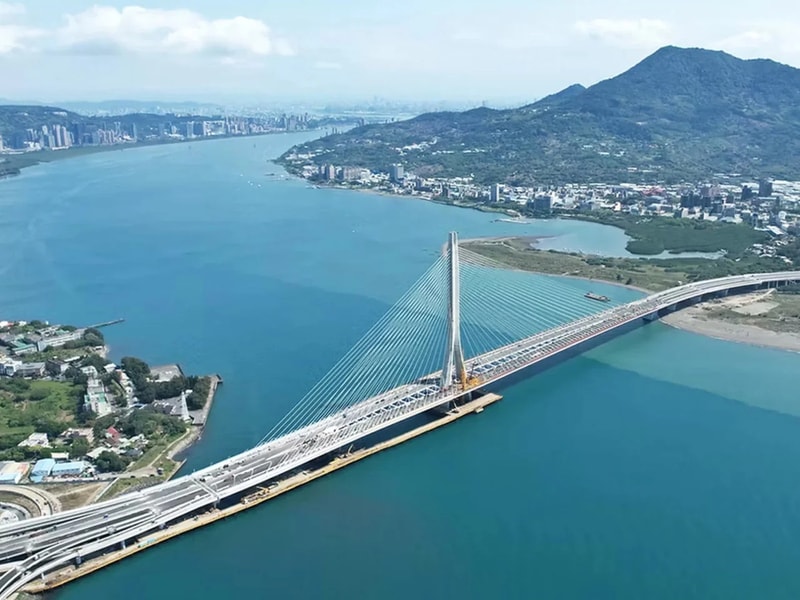
Zaha Hadid Architects has completed the Danjiang Bridge across the Tamsui River estuary in New Taipei City, creating a new connection between the districts of Tamsui and Bali. Spanning 920 meters, the structure is defined by a single 200-meter-tall concrete mast that supports the crossing through an asymmetric cable arrangement.
The design was developed to minimize visual disruption to the surrounding landscape and preserve views across the estuary, particularly the area’s well-known sunsets. A 450-meter main span extends west of the tower, while a secondary 175-meter span reaches eastward, creating a distinctive profile across the river.
The 71-meter-wide deck accommodates motor vehicles, pedestrians, cyclists, and a future extension of the Danhai Light Rail system. Engineering systems including cable stays, hydraulic dampers, friction pendulum bearings, and synthetic rubber pads enable the bridge to withstand earthquakes of magnitude seven or greater.
Image Credit: Zaha Hadid Architects
What's Driving This Trend
- Single-mast Long-span Bridges
- A concentrated-mast approach enables longer uninterrupted spans with reduced in-water supports, presenting potential for novel materials and construction methods that redefine river-crossing footprints.
- Asymmetric Cable-stayed Design
- Asymmetrical cable arrangements create distinctive visual identities while enabling optimized load paths, opening possibilities for bespoke structural systems and parametric design-to-construction workflows.
- Seismic-resilient Bridge Systems
- Integrated seismic technologies such as hydraulic dampers and friction pendulum bearings indicate a move toward adaptive, performance-based bridges that could spur modular resilience components and monitoring platforms.
Who This Affects Most
- Infrastructure Development
- Large-scale transport projects may shift toward slimmer, iconic crossings that balance cost and environmental sensitivity, encouraging new procurement models and prefabrication supply chains.
- Urban Transit Integration
- Designing bridges to accommodate future light-rail and multimodal traffic suggests opportunities for transit-first bridge typologies and interoperable track-deck solutions.
- Architectural Engineering Firms
- Firms that combine signature aesthetics with advanced structural engineering stand to pioneer cross-disciplinary studios and digital fabrication techniques for landmark infrastructure.