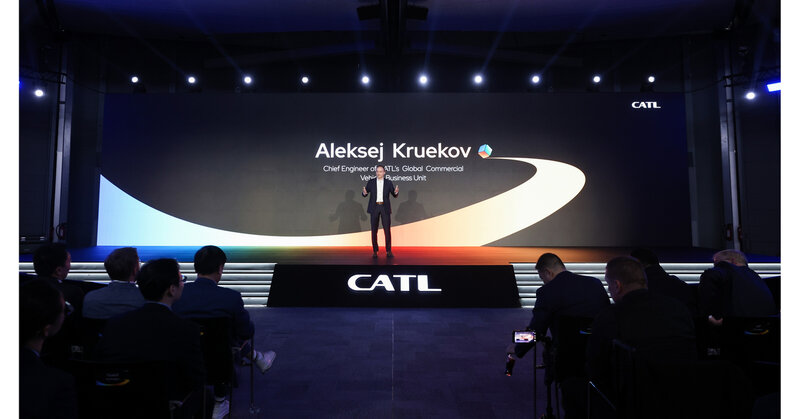
CATL introduced TECTRANS II, a modular battery platform for commercial vehicles featuring standardized packs that can be combined to meet varying energy and payload needs. The system is compatible with both e-axle and central-drive layouts and supports either plug-in charging or battery swapping. The platform standardizes external dimensions, electrical connections and communication so packs and vehicle platforms can evolve independently.
TECTRANS II offers a gravimetric energy density of 170 Wh/kg and a maximum configuration that extends driving range to about 1,000 kilometers. It supports very fast charging that restores 80% capacity in roughly 25 minutes using megawatt-class chargers and achieves around 96% round-trip efficiency with a full-tab low-impedance design. CATL cites a 12-year, 1.5-million-kilometer service life target with 70% capacity retention for heavy-duty truck packs.
The modular approach aims to cut OEM development time and R&D costs while improving fleet economics through higher payload, longer range and quicker turnaround. Robust casing, impact and corrosion resistance, system redundancy and insulation-fault diagnostics are designed to keep vehicles running in demanding operations, supporting lower lifecycle costs for fleets.
Image Credit: CATL
What's Driving This Trend
- Modular Battery Platforms
- Standardized pack architectures create room for commercial vehicle makers to shorten development cycles while enabling fleets to tailor energy capacity, payload and range to specific duty cycles.
- Megawatt Fast Charging
- Ultra-rapid charging compatibility reshapes heavy-duty electrification by reducing vehicle downtime and making long-haul electric trucking more operationally viable.
- Battery Swapping Flexibility
- Interchangeable battery systems introduce new fleet models where uptime, asset utilization and energy replenishment can be optimized independently from vehicle ownership.
Who This Affects Most
- Commercial Vehicles
- Electric trucks and buses gain stronger business cases as modular batteries support longer range, higher payload efficiency and lower lifecycle operating costs.
- Battery Manufacturing
- Pack standardization signals a shift toward scalable component ecosystems where suppliers can serve multiple vehicle platforms without fully customized designs.
- Charging Infrastructure
- Megawatt-class charging networks become more critical as high-capacity commercial fleets require fast, reliable energy access across logistics corridors and depots.