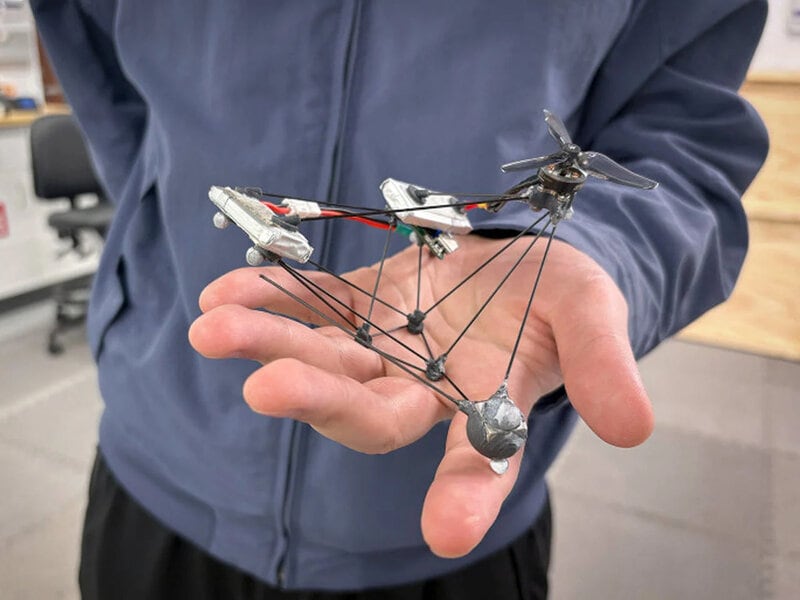
Phantom Twist is an experimental drone developed by researchers at Northwestern University that reduces its visibility by spinning its entire body during flight. Instead of relying on a conventional quadcopter design, the drone uses a single motor and propeller that rotate the chassis at approximately 25 revolutions per second, causing the aircraft to appear as a faint blur to the human eye. The project was presented at the Robotics: Science and Systems 2026 conference as a demonstration of low-visibility flight through persistent motion.
The research team evaluated thousands of AI-generated configurations before selecting a stable design built around a motor, circuit boards, battery, and counterweight. By eliminating stationary external components, the drone is significantly harder to detect than a traditional quadcopter while maintaining controlled flight.
Image Credit: Northwestern University
Why This Trend Is Growing
- Motion-camouflaged Robotics
- Continuous body rotation introduces new stealth design possibilities for aerial systems used in monitoring, inspection, and security-sensitive environments.
- AI-generated Drone Design
- Algorithmic evaluation of thousands of physical configurations signals a faster path to unconventional aircraft architectures with novel performance advantages.
- Minimalist Propulsion Systems
- Single-motor flight platforms point to lighter, simpler drone builds that may reduce mechanical complexity while enabling specialized use cases.
Industries Being Reshaped
- Aerospace
- Low-visibility micro-aircraft concepts could reshape defense, reconnaissance, and experimental aviation markets through unconventional flight mechanics.
- Robotics
- Persistent-motion camouflage expands the design space for autonomous machines requiring discreet navigation in complex real-world settings.
- Security
- Hard-to-detect aerial devices create emerging demand for advanced surveillance, counter-drone detection, and protected airspace technologies.