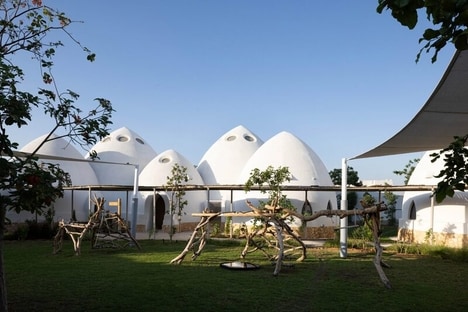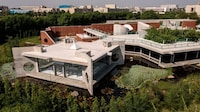
The Nokha Village Community Centre by Sanjay Puri Architects represents a thoughtful architectural intervention in the arid landscape of Rajasthan, India. Designed as both a memorial and a multipurpose hub, the project blends cultural sensitivity, environmental responsiveness, and community functionality.
The Nokha Village Community Centre spans 13,000 square feet and serves the surrounding 144 villages by addressing educational and social needs through innovative spatial planning. The organic, curvilinear form rises dynamically from the northeastern corner, wrapping around to create a north-facing courtyard that serves as a natural gathering space protected from harsh sunlight. This inclined spiral structure doubles as a rooftop garden with varying slopes, offering recreational space and panoramic views of the desert while also functioning as a passive cooling mechanism. Below, the building houses a children’s digital library, a small museum, and an amphitheater for performances and communal events.
Material selection and climate-responsive strategies play a crucial role in the design. The library’s sandstone screens, which were inspired by traditional Rajasthani jali work, filter sunlight and cast shifting shadow patterns. Through this, the design elements reduce heat gain while maintaining visual connectivity. A grass-covered earth berm on the southern side further insulates the interiors from extreme temperatures, which frequently exceed 40°C.
Image Credit: Vinay Panjwani
Key Themes Behind This Trend
- Climate-responsive Architecture
- Architectural designs that incorporate climate adaptability, such as the Northeastern-oriented courtyard, provide energy-efficient cooling in extreme temperatures.
- Cultural Integration in Design
- The fusion of traditional aesthetics with modern functionality showcases a movement towards culturally integrated architectural solutions like the use of jali-inspired screens.
- Multipurpose Community Spaces
- Increasing demand for versatile community hubs that serve educational, social, and recreational purposes is highlighted by multifunctional developments like the Nokha Village Community Centre.
Where This Applies
- Sustainable Building Materials
- The use of materials that merge traditional elements with ecological benefits indicates growth in the sector supporting sustainable construction practices.
- Green Roofing and Landscaping
- Rooftop gardens with multifunctional capabilities are driving innovations in the green roofing industry, as seen in the spiral structure's recreational and cooling benefits.
- Community-centric Development
- The focus on creating spaces that serve multiple societal functions embodies the expanding trend within industries centered on community-focused infrastructure.