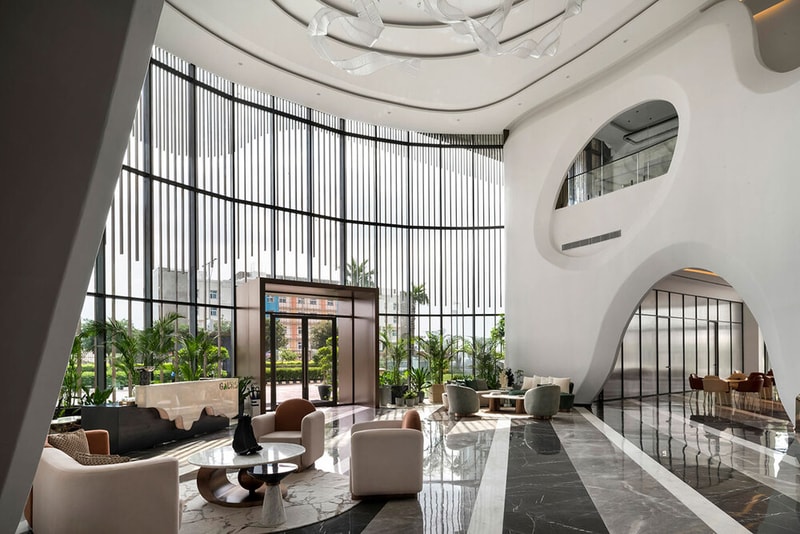
The Gaur NYC Experience Centre is a sales gallery in Ghaziabad, India, designed by Confluence for Gaurs Group as a real estate showroom. The project draws on organic forms inspired by caves shaped by flowing water, resulting in curved white walls, sculptural surfaces, and fluid spatial transitions throughout the interior. The entrance features angled glass panels and vertical metal louvers that create a wave-like effect, establishing the natural design language from the outset. A double-height atrium anchors the space, where greenery is arranged over river rocks to define zones within the open plan.
The interior incorporates polished marble flooring with diagonal slabs, adding contrast to the soft architectural forms. Semi-transparent partitions, portals, and glass doors maintain visual continuity while subtly dividing areas. Overhead, a ribbon-like light installation appears suspended, contributing to the layered ceiling composition.
Image Credit: Confluence
What Makes This Trend Stand Out
- Biomorphic Architectural Forms
- Curved, cave-inspired geometries enable spaces that feel sculptural and immersive, opening possibilities for sensory-driven spatial narratives that redefine client engagement.
- Fluid Spatial Branding
- Sales environments organized as continuous, flowing sequences offer cohesive brand storytelling through architecture, creating opportunities to blend marketing and experiential design seamlessly.
- Integrated Natural Elements
- The incorporation of greenery, river rocks, and natural textures into interior compositions suggests new product ecosystems marrying landscape materials with built-environment finishes for wellbeing-focused spaces.
Sectors Adopting This
- Real Estate Showrooms
- Showcase environments that mimic natural formations can transform property presentation into immersive experiences, influencing buyer perception and valuation through atmospheric design.
- Luxury Retail
- Boutiques adopting sculptural white surfaces and ribbon lighting present high-end merchandise within gallery-like contexts, enabling elevated merchandising and personalized discovery.
- Hospitality and Wellness
- Resorts and spas that use fluid spatial transitions and biophilic accents create restorative atmospheres, suggesting integrated service models centered on sensory and therapeutic architecture.