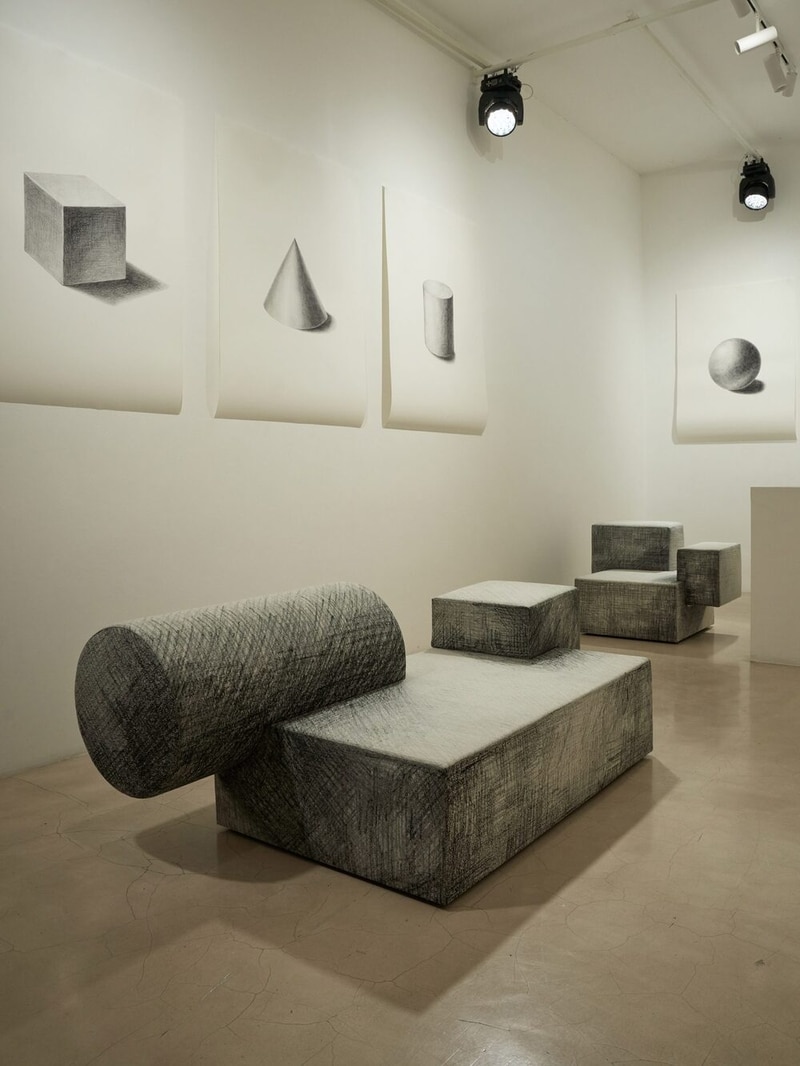
Front’s Geometrie collection for Moroso presents a series of furniture pieces derived directly from three-dimensional perspective drawings. Front’s Geometrie collection uses wireframe-like structures that replicate the lines of hand-drawn sketches, translating two-dimensional perspective grids into physical seating forms. Chairs and tables appear as if they are lifted from architectural drawings, with intersecting lines defining volume, proportion, and depth in space.
Front’s design approach builds each piece from thin metal rods arranged to follow perspective logic, creating structures that read as outlines rather than solid mass. The geometry exaggerates vanishing points and distorted proportions typical of perspective drawings, resulting in forms that shift visually depending on the viewing angle. Moroso’s production translates these drawings into functional objects, where seating surfaces and supports are integrated within the linear framework.
Image Credit: Lorenzo Bacci, Massimo Gardone-Azimut
Why This Trend Is Growing
- Sketch-to-object Manufacturing
- This trend envisions manufacturing pipelines that convert hand-drawn or digital perspective sketches directly into producible furniture geometries, collapsing prototyping timelines and enabling one-to-one translation of creative intent.
- Wireframe Aesthetic Revival
- Designs that emphasize skeletal, line-based structures create new visual languages for products, enabling lightweight construction and novel material economies while reframing perceptions of solidity and comfort.
- Perspective-driven Form Exploration
- By using exaggerated vanishing points and distorted proportions as generative rules, designers can produce adaptable pieces whose perceived volume and function shift with viewer position, opening possibilities for context-sensitive furnishings.
Industries Being Reshaped
- Furniture Manufacturing
- Traditional producers face opportunities to integrate parametric workflows and automated metal-bending or welding systems that translate perspective-based designs into repeatable, scalable products.
- Interior Design
- Spatial planners and studios can leverage perspective-derived furnishings to create dynamic environments where perceived room geometry and circulation are altered by furniture that reads differently from multiple vantage points.
- Digital Fabrication and 3D Printing
- Advanced fabrication providers could enable complex wireframe structures and hybrid assemblies using optimized lattice printing and modular joining techniques that reconcile delicate aesthetics with structural requirements.