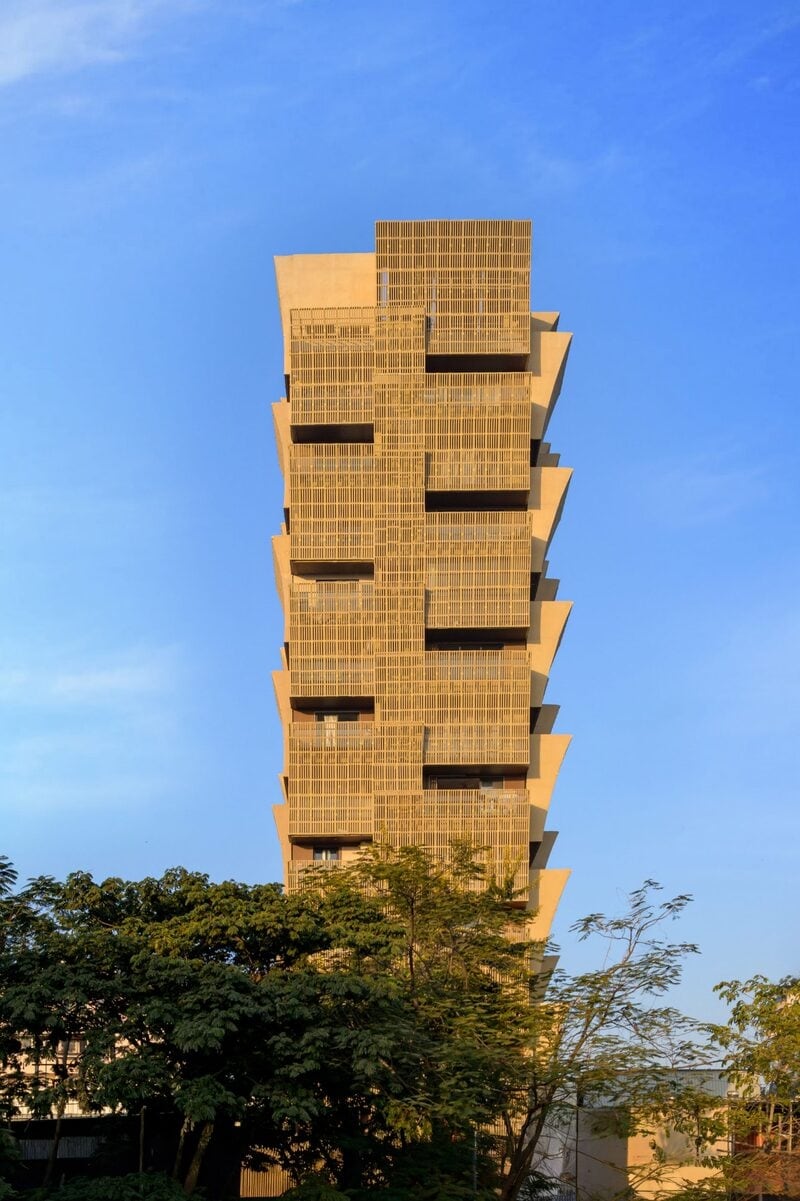
The Cielo residential building is a housing project in Nagpur, India designed by Sanjay Puri Architects that responds to climate conditions through façade articulation and spatial planning. The building contains one four-bedroom apartment per floor, arranged to allow cross ventilation and access to outdoor space from all major rooms. Living areas open onto balconies positioned on opposite sides of the plan, supporting airflow and reducing reliance on mechanical cooling.
A defining feature of the project is its layered exterior screen system, composed of curved elements that wrap the building in alternating horizontal and vertical bands. These screens reference perforated shading devices used in Indian architecture since the 17th century to manage sunlight, heat, and privacy. The screens also create semi-outdoor zones that act as thermal buffers between interior spaces and the external environment. Sustainability measures include rooftop solar panels, water harvesting, and recycling systems integrated into the building’s infrastructure.
Image Credit: Vinay Panjwani
Why This Trend Is Growing
- Climate-adaptive Façades
- Buildings employing layered, operable screening systems that modulate sunlight and airflow create opportunities for integrating sensor-driven materials and responsive shading technologies.
- Bioclimatic Unit Layouts
- Apartment plans prioritizing cross-ventilation and semi-outdoor rooms enable development of modular housing typologies optimized for passive cooling in hot climates.
- Integrated Resource Infrastructure
- Rooftop solar, rainwater harvesting and on-site recycling combined within residential projects point toward compact, building-level utility platforms that reduce dependence on centralized systems.
Industries Being Reshaped
- Architectural Materials
- Manufacturers of perforated and curved façade components stand to benefit from demand for lightweight, durable shading elements tailored to bespoke geometries.
- Smart Building Systems
- Advanced sensor networks and control software for airflow and solar shading could be paired with mechanical systems to create hybrid climate control solutions.
- Prefabricated Housing
- Factory-Built modules designed for passive ventilation and pre-integrated solar and water systems could accelerate affordable climate-responsive housing deployment.