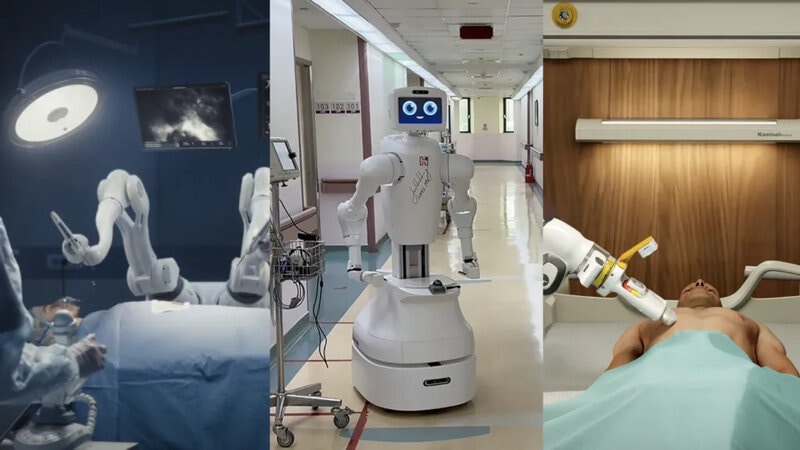
Nvidia introduced the Medical Physics Simulation framework as an open-source addition to its Isaac for Healthcare platform, helping surgical and diagnostic robots learn through embodied experience. The framework combines classical physics solvers with generative simulation to recreate the contact, force and soft-tissue interactions robots would normally encounter during real procedures.
The system pairs deterministic mechanics, such as catheter movement and tissue resistance, with Cosmos-H Dreams, a generative component that models visual and anatomical variation. Nvidia Warp and Newton enable thousands of parallel training environments, allowing developers to generate rare procedural edge cases on demand. Early adopters include CMR Surgical, Johnson & Johnson MedTech and Medtronic, which are contributing data or developing digital twins for urology, endovascular and catheter-navigation research.
For clinicians and device teams, the framework could accelerate embodied training, dataset generation and pre-hardware development. Its open-source design also allows auditors to inspect modelling assumptions, although real-world validation remains essential before clinical deployment.
Image Credit: Nvidia
Key Themes Behind This Trend
- Embodied Robot Training
- Physics-rich virtual environments give surgical and diagnostic robots exposure to procedural complexity before real-world deployment, opening space for faster skill acquisition and safer autonomy testing.
- Generative Digital Twins
- Synthetic anatomy, visual variation and procedural edge cases expand how medical device teams model patient diversity, creating new possibilities for validation beyond limited clinical datasets.
- Open-source Clinical Simulation
- Transparent simulation frameworks make modeling assumptions more inspectable for developers, clinicians and auditors, supporting new trust mechanisms around AI-enabled medical robotics.
Where This Applies
- Medical Robotics
- Parallel physics simulation can compress development cycles for robotic surgery systems by enabling high-volume training across rare tissue interactions and instrument behaviors.
- Medtech
- Device manufacturers gain a pre-hardware testing layer for catheter navigation, endovascular tools and surgical instruments, reshaping how products are prototyped and evaluated.
- Healthcare AI
- AI-driven simulation infrastructure broadens access to synthetic clinical data and embodied learning environments, strengthening the foundations for adaptive diagnostic and procedural systems.