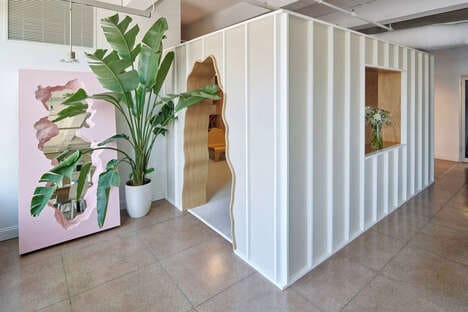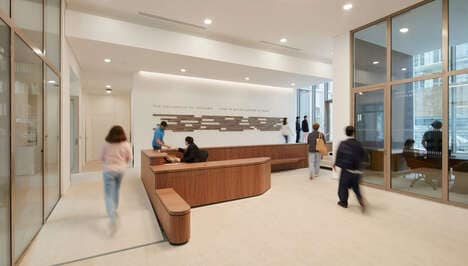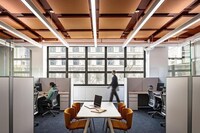
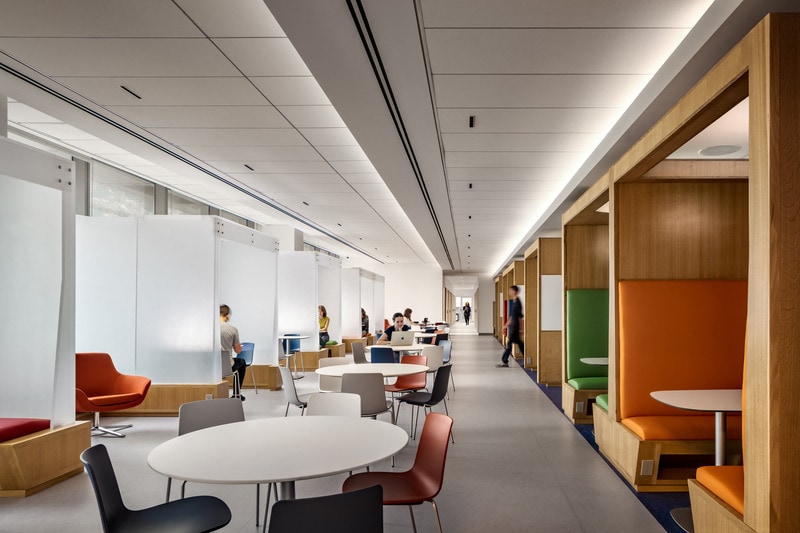
Shakespeare Gordon Studio completed the John Jay Club Row project this year, a significant interior redesign initiative aimed at enhancing student life at John Jay College of Criminal Justice. The core design philosophy centers on fostering open collaboration and community building through a thoughtful layout that accommodates diverse activities, from individual study to large club gatherings.
As part of the John Jay Club Row project, Shakespeare Gordon Studio transformed a previously fragmented and underutilized series of rooms into a cohesive, multi-functional hub strategically located in a high-visibility atrium area. Key features include custom-designed millwork booths arranged to leverage natural light, a dedicated multipurpose room with flexible partitioning, and specialized spaces like a newsroom and recording studio to meet specific club requirements. The material selection — incorporating white oak, translucent acrylic, and sound-dampening felt — is presented as a deliberate effort to create an environment that is simultaneously warm, vibrant, functional, and acoustically comfortable.
Image Credit: Alexander Severin
What's Driving This Trend
- Flexible Learning Spaces
- The shift towards adaptable areas that can be used for a variety of educational and extracurricular purposes highlights a trend in creating environments that support versatile learning approaches.
- Community-centric Campus Design
- There is a growing emphasis on architectural design that prioritizes social interactions and collaborative opportunities, fostering stronger community engagement within educational institutions.
- Sustainable and Acoustic-friendly Materials
- The use of materials that enhance both sustainability and acoustics in educational environments is becoming increasingly significant, driving innovations focused on comfort and environmental consciousness.
Who This Affects Most
- Educational Architecture
- As educational institutions seek to update their facilities, the industry is focusing on creating spaces that are both aesthetically pleasing and functionally versatile.
- Interior Design
- Interior design firms are innovating to craft environments that cater to diverse, multipurpose uses, particularly in educational settings where adaptability is key.
- Furniture and Fixtures
- In response to modern needs, the furniture and fixtures industry is developing custom solutions that maximize space usage and enhance learning experiences.