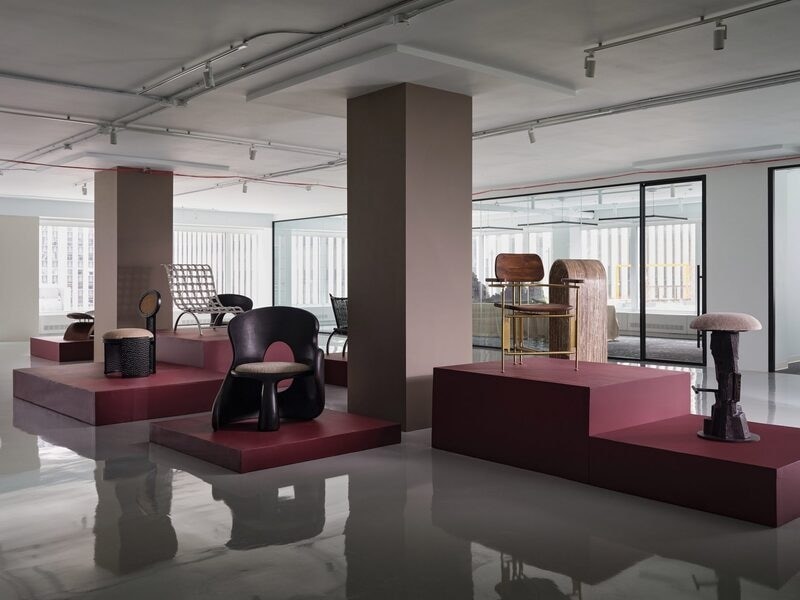
House of Santal Edition 1 presents contemporary furniture and craft in Manhattan within a former Midtown office space converted into a design gallery. The exhibition is the first installation for House of Santal, a gallery founded by Raksha Sanikam to platform both emerging and established practitioners of contemporary South Asian design. The space is organized around plinths that reference the central courtyards of historical Indian houses, creating immersive vignettes for curated pieces.
The inaugural show highlights work by multiple South Asian designers, featuring handmade furniture, sculptural seating, and crafted objects that reinterpret traditional techniques for a modern context. Pieces on display include benches with textured surfaces, chairs that combine structural steel with woven elements, and wall sculptures integrating innovative material use.
Image Credit: Joe Kramm
Key Themes Behind This Trend
- Contextual Courtyard Plinths
- The adaptation of historical courtyard layouts into gallery plinth arrangements reveals opportunities for immersive spatial storytelling that redefines how objects are contextualized and experienced.
- Contemporary South Asian Craft Revival
- A renewed focus on South Asian artisanal techniques blended with contemporary design points to scalable models that elevate regional makers into global design conversations.
- Hybrid Material Furniture
- The fusion of structural metals with traditional woven elements indicates possibilities for new product categories that merge industrial performance with handcrafted aesthetics.
Where This Applies
- Design Galleries and Curatorial Spaces
- Boutique galleries converting unconventional commercial spaces illustrate potential for immersive retail-curatorial hybrids that transform exhibition formats and visitor engagement.
- Furniture Manufacturing and Craft Production
- Collaborations between small-scale artisans and contemporary makers suggest frameworks for localized manufacturing that balance customization with repeatable production.
- Textile and Material Innovation
- Experimental integration of woven elements with engineered substrates highlights opportunities for advanced materials development that prioritizes tactile heritage alongside technical performance.