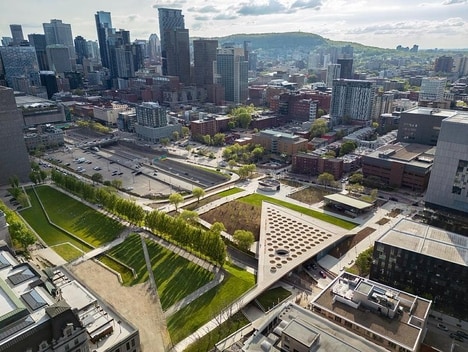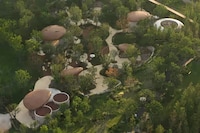
Projet Paysage, in collaboration with architecture firm Cardin Julien, has transformed a former petrochemical brownfield in Laval, Canada, into a civic landscape called Espace citoyen des Confluents. This project is noteworthy for integrating a library, cultural spaces, and municipal services within a 13-acre site crisscrossed with pathways, rest areas, and an active mobility network.
The strategic civic landscape project reverses the industrial degradation of the land by recreating natural regeneration processes — a network of permeable pathways, drainage trenches, and interconnected basins captures 100% a network of permeable pathways, drainage trenches, and interconnected basins captures. This volume is slowly directed it through wetlands that foster wildlife habitats. More than 300 trees across 25 species have been planted alongside spontaneous vegetation that establishes biological corridors.
Image Credit: Vincent Brillant
Why This Trend Is Growing
- Brownfield Civic Regeneration
- New models for funding, governance and mixed-use programming emerge from transforming contaminated industrial sites into publicly accessible civic landscapes.
- Nature-based Remediation Systems
- Ecological engineering practices that combine permeable pathways, drainage networks and constructed wetlands enable scalable approaches to pollution mitigation and habitat restoration.
- Integrated Cultural-municipal Hubs
- Co-locating libraries, cultural venues and municipal services within a single redeveloped site supports hybrid service delivery models and multifunctional public realms.
Industries Being Reshaped
- Urban Planning
- Shifts in land-use priorities toward resilience and public access create demand for planning frameworks that reconcile environmental remediation with community amenities.
- Landscape Architecture
- Design strategies that foreground spontaneous vegetation and biological corridors unlock opportunities for productized green-infrastructure solutions and maintenance landscapes.
- Environmental Remediation
- Advances in passive water management and habitat-centric cleanup methods point to lower-cost, nature-integrated remediation business models.