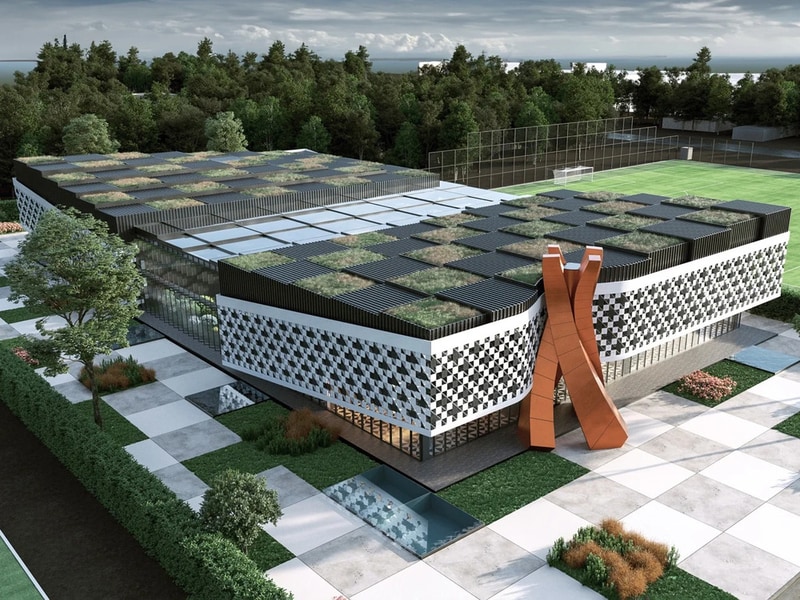
The Batumi Chess Palace is a proposed cultural building in Georgia designed to translate the structure of a chessboard into architecture. The project uses a black-and-white grid arranged across the façade, directly referencing the alternating squares of a chessboard. The geometry extends beyond surface treatment, informing the organisation of interior spaces and circulation paths. The design is based on an unfolded board concept, allowing the grid to wrap and shift across different elevations while maintaining a consistent visual system.
The building is planned as a dedicated venue for chess tournaments, exhibitions, and educational programmes. Openings are integrated within the grid to introduce daylight and ventilation without disrupting the pattern. A large-scale chess piece element is incorporated at the entrance, reinforcing the theme at an architectural scale while guiding visitors into the main public areas of the structure.
Image Credit: Irakli Emiridze, Alpha Architecture
What Makes This Trend Stand Out
- Pattern-led Façade Systems
- A shift toward façades that encode symbolic patterns creates opportunities for façades to act as cultural signifiers and integrated environmental control systems.
- Thematic Spatial Programming
- Buildings organized around narrative or game-based frameworks enable programmatic flows and public engagement models that redefine multifunctional cultural spaces.
- Modular Grid Architecture
- Using an adaptable grid language across elevations suggests new prefabricated modular systems that standardize assembly while allowing expressive variation.
Sectors Adopting This
- Cultural Venue Design
- Designers of museums and event spaces may exploit motif-driven architecture to create highly marketable, identity-rich venues that blend exhibition, education, and performance.
- Facade Manufacturing
- Manufacturers of cladding and engineered panels could develop configurable black-and-white grid systems that integrate daylighting, ventilation, and rapid installation.
- Educational Technology
- Providers of learning platforms and interactive exhibits can leverage architecture-themed curricula and spatially integrated interfaces to deepen participant engagement with specialized subjects like chess.