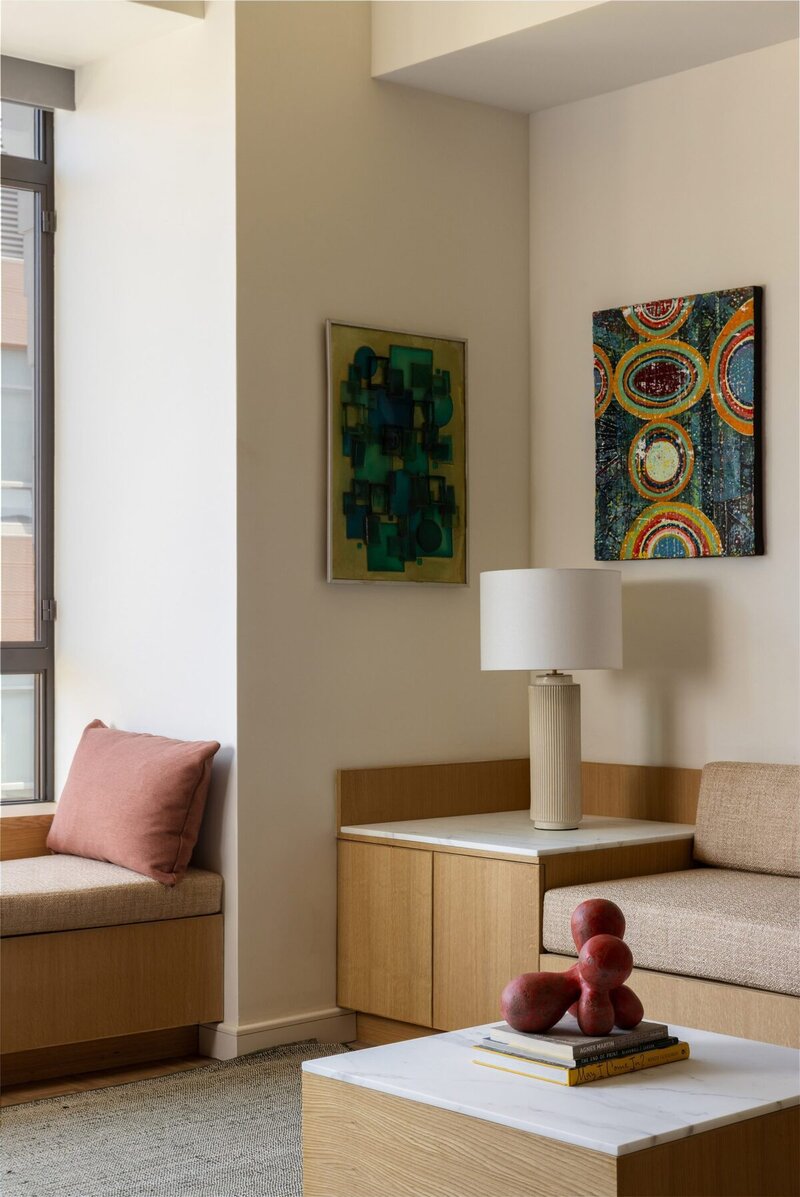
The Barrow Street Loft was renovated by Brooklyn-based Studio Vural inside a former 1920s herring canning factory in New York's West Village. Removing mirrored walls and other additions from an 1980s conversion revealed the building's original concrete columns, beams and parquet flooring, which were retained alongside new interventions. The 1,500-square-foot residence is organized around a series of oak-clad "pods" that create flexible bedrooms, a home office and a lofted reading nook while preserving an open living area designed for entertaining.
Tonal green accents appear throughout the apartment, contrasting with oak millwork, exposed concrete and brass details. Green felt wraps ceiling beams above the mezzanine and covers the staircase leading to the reading nook. At the same time, the kitchen and bathrooms feature green tiles paired with custom oak cabinetry. Glass blocks and spandrel windows introduce light into the enclosed pod volumes. Bespoke built-in furniture maximizes functionality across the adaptable layout while celebrating the industrial character of the former factory.
Image Credit: Kate Glicksberg
Why This Trend Is Growing
- Adaptive Industrial Living
- Former factory interiors are becoming premium residential canvases where preserved concrete, parquet and structural remnants support distinctive homes with heritage-rich character.
- Flexible Pod Interiors
- Oak-clad modular rooms within open lofts point to demand for reconfigurable spaces that balance privacy, work, leisure and entertaining in compact urban residences.
- Material-color Zoning
- Tonal green finishes, brass details and warm millwork show how color and texture can define functional zones without sacrificing openness or architectural continuity.
Industries Being Reshaped
- Residential Interior Design
- Design studios have room to differentiate by blending bespoke built-ins, flexible layouts and historic preservation into highly functional urban homes.
- Real Estate Development
- Adaptive reuse properties offer developers a way to convert aging industrial assets into character-driven residences aligned with demand for authentic city living.
- Architectural Materials
- Opportunities are emerging for glass blocks, acoustic felts, custom wood systems and decorative tiles that improve light, function and atmosphere in renovated loft environments.