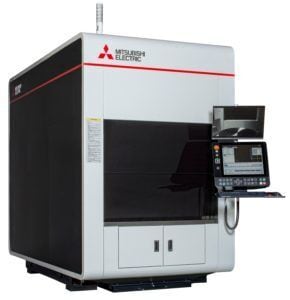
Mitsubishi Electric has created two 'AZ600' direct energy deposition (DED) 3D printers. These two printers are the 2kW AZ600-F20 and the 4kW AZ600-F40, with the major difference being the oscillator power. Both printers have 5-axis spatial control and an expansive work volume of 50cm x 50cm.
Mitsubishi Electric claims that these printers are a world's first in stable, high-quality 3D printing due to the welding wire-melting technology that the printers use. As for the practical use of these printers, Mitsubishi Electric believes that its maintenance and repair sectors can benefit greatly from this technology. In fact, the company estimates these printers are 80% more material-efficient, are quicker, and are more energy-efficient than its previous part creation methods.
Image Credit: Mitsubishi Electric
What Makes This Trend Stand Out
- Direct Energy Deposition 3D Printing
- Mitsubishi Electric's AZ600 3D printers employ direct energy deposition technology for high-quality and efficient part creation.
- 5-axis Spatial Control
- Mitsubishi Electric's AZ600 3D printers incorporate 5-axis spatial control for greater design flexibility and precision.
- High-volume Workspaces
- Mitsubishi Electric's AZ600 3D printers offer expansive work volumes of 50cm x 50cm, enabling the production of large and complex parts.
Sectors Adopting This
- Manufacturing
- Manufacturing companies can benefit from the efficient, high-quality, and flexible part creation capabilities offered by Mitsubishi Electric's 3D printers.
- Maintenance and Repair
- Maintenance and repair sectors can take advantage of Mitsubishi Electric's high-quality, energy-efficient, and cost-effective part creation capabilities using the AZ600 3D printers.
- Aerospace
- The aerospace industry can benefit from the precise, high-quality, and scalable part creation capabilities offered by the AZ600 3D printers for the production of complex and large parts.