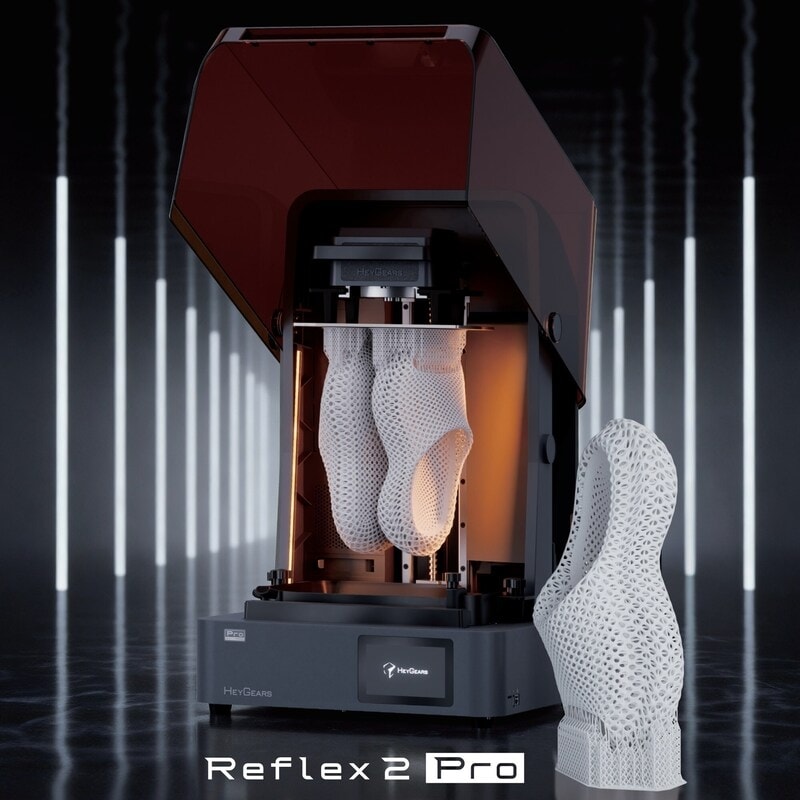
HeyGears has recently announced the launch of two new models in its series of 3D printing systems — the Reflex 2 Pro and the Reflex 2. These devices are resin-based printers intended for professional and industrial applications, with a stated focus on moving beyond prototyping to the production of end-use components.
The higher-tier model, the Reflex 2 Pro, is highlighted for its significantly increased build volume and incorporates specific technological features, including a light engine with numerous individually controlled zones for precision, a durable screen component, a high-precision motor, and an integrated temperature management system. Both HeyGears printers are compatible with a range of specialized printing materials, including a new resin noted for its thermal and deformation resistance.
Image Credit: HeyGears
What's Driving This Trend
- Precision-controlled 3D Printing
- Advanced printing systems like the Reflex 2 Pro offer opportunities for enhanced precision in manufacturing with innovations such as individually controlled light engine zones.
- End-use Component Production
- The shift of 3D printing from prototyping to end-use component production presents transformative opportunities for industries seeking durable and customized parts.
- Multi-material Printing Systems
- Printers compatible with specialized materials, such as thermally resistant resins, pave the way for innovations in multi-material and high-performance printing applications.
Who This Affects Most
- Manufacturing
- Manufacturing industries are poised to benefit from 3D printing systems that enable rapid production of complex and precise components.
- Aerospace
- The aerospace sector stands to revolutionize its assembly line by leveraging large-volume 3D printing for durable, high-precision parts.
- Healthcare
- Healthcare can see transformative improvements with 3D printing technology supporting the creation of custom, patient-specific medical devices and prosthetics.