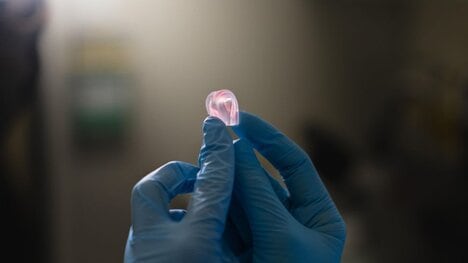
Bioinspired printable tissues are advancing materials science by creating 3D-printable structures that replicate the selective filtering and transport functions of living human tissue. Researchers at the University of Texas at Austin developed a scalable process that rapidly forms tissue-like materials from billions of microscopic water droplets separated by thin membranes. The resulting material can be customized for applications ranging from tissue engineering and organ scaffolds to soft robotics, wastewater treatment and brain-inspired computing. Its ability to mimic biological functions rather than simply biological form expands the potential uses of 3D-printed materials across multiple industries.
For businesses, this platform could accelerate the development of next-generation medical devices, advanced filtration systems and adaptive robotic technologies using a single manufacturing approach. The scalable production method also lowers barriers for research and commercialization, making it easier for laboratories and companies to explore new applications. As demand grows for multifunctional biomaterials, tissue-inspired platforms could become an important foundation for future healthcare, environmental and industrial technologies.
Image Credit: The University of Texas at Austin
What's Driving This Trend
- Functional Biomimetic Materials
- Materials that replicate living tissue behaviors rather than surface appearance create openings for adaptive products across healthcare, robotics and environmental systems.
- Scalable Soft-matter Printing
- Rapid fabrication of droplet-based structures introduces new potential for lower-cost prototyping and commercialization of complex multifunctional materials.
- Bioinspired Filtration Platforms
- Selective transport functions modeled on human tissue suggest more efficient approaches to water treatment, diagnostics and controlled molecular separation.
Who This Affects Most
- Medical Devices
- Tissue-like printable materials could reshape device development through customizable scaffolds, regenerative interfaces and biologically responsive components.
- Wastewater Treatment
- Membrane-separated droplet architectures present new possibilities for filtration systems that mimic biological selectivity while supporting scalable production.
- Soft Robotics
- Robotic systems may benefit from printable materials that combine flexibility, transport functions and tissue-inspired responsiveness in a single platform.