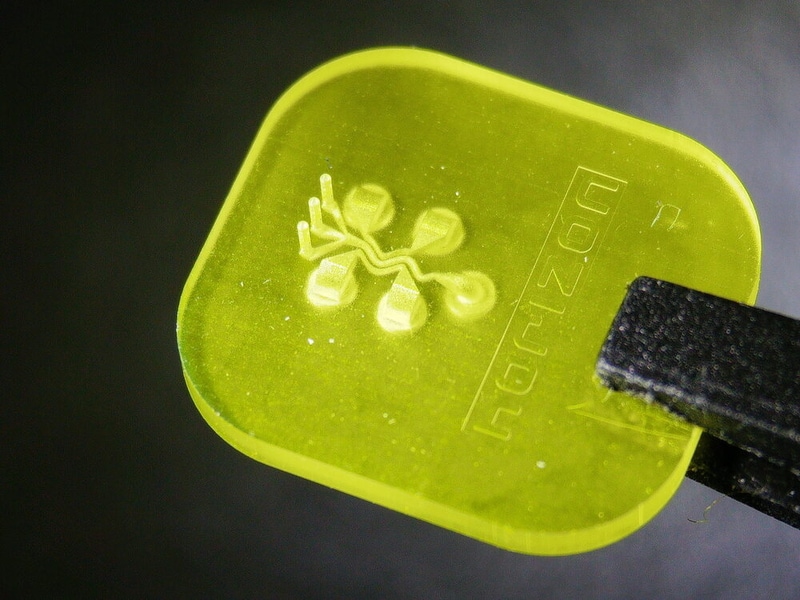
Horizon Microtechnologies introduced a print–develop–coat workflow that produces micro-scale polymer parts using Boston Micro Fabrication’s Projection Micro Stereolithography, featuring proprietary coatings that modify surface and electrical properties. The company positioned the process to create leak-free, fully 3D channel networks without bonded layer interfaces, aiming to simplify device fabrication for microfluidics.
The system can print internal channels, microneedles and complex internal geometry and then apply distinct coatings to different regions to tune hydrophilicity, conductivity or biocompatibility; resins were tested to ISO 10993-1:2018. Horizon said parts can be optically clear and electrically functional, enabling integrated electrodes and optics in a single printed component.
For users, the approach could reduce assembly steps and lower costs by delivering closer-to-finished lab-on-a-chip cartridges and microneedle arrays ready for testing and scale-up, aligning with trends toward compact, multifunctional diagnostic and dosing devices.
Image Credit: Horizon Microtechnologies
Why This Trend Is Growing
- Functional Coating Differentiation
- A process that allows region-specific modification of hydrophilicity, conductivity and biocompatibility for single-part devices, creating opportunities to replace multi-component assemblies with coated monoliths.
- Monolithic Microfluidic Fabrication
- The elimination of bonded layer interfaces through single-print internal channels presents pathways for leak-free, high-yield microfluidic cartridges that reduce downstream assembly complexity.
- Integrated Electro-optical Printing
- Optically clear and electrically functional printed parts enable embedding of electrodes and optical paths within one component, which can compress sensing, actuation and fluid handling into unified devices.
Industries Being Reshaped
- Point-of-care Diagnostics
- Lab-on-a-chip cartridges produced near final form factor with tailored coatings could shift test manufacturing toward compact, lower-cost disposable diagnostics with integrated sensing elements.
- Transdermal Drug Delivery
- Microneedle arrays with localized biocompatible and hydrophilic coatings allow for single-piece dosing platforms that combine mechanical delivery structures with surface-tuned tissue interactions.
- Lab Automation and Microfluidic Instrumentation
- Complex internal geometries and embedded electrical/optical features in monolithic parts can enable more compact, maintenance-light fluidic modules for automated sample processing and analysis.