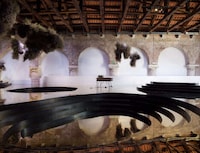
The 'Garden for the Eyes' installation by c+d studio presents an innovative reinterpretation of traditional Jiangnan garden aesthetics through a contemporary spatial experience. This conceptual work, created for the 'Creation | New Jiangnan Space Art' exhibition in Shanghai, transforms classical garden elements — like courtyards, bridges, wells, and corridors — into an abstract, human-scale journey where visitors explore the environment solely through visual perception.
The designers faced significant spatial constraints within the 16mx6m exhibition area, resolving this challenge through meticulous scale reduction that compresses the 'Garden for the Eyes' experience into a 40-meter-long, single-person pathway suspended at precise heights to guide eye movement. The installation's materiality emphasizes purity and lightness, and it is constructed primarily from Anhui handmade leatherette paper and pine wood frames. These materials refer to traditional Chinese artistic media. An integral component of the work is its dialogue with 27 abstract ink painting reproductions by Lyu Wujiu, where the architectural space becomes both exhibit and exhibition platform.
Image Credit: Xian Song
Key Themes Behind This Trend
- Spatial Compression Design
- Shrinking large spaces into compact, navigable environments enhances visitor experiences by offering an innovative approach to spatial storytelling.
- Cultural Reinterpretation in Art
- Blending traditional cultural elements with modern design facilitates new ways for audiences to connect with heritage in immersive environments.
- Material Use in Exhibition Spaces
- Utilizing unconventional materials like handmade leatherette paper in installations can create unique textures and engagement in art exhibits.
Where This Applies
- Exhibition Design
- The rise of immersive, culturally nuanced installations offers fresh opportunities for designers to craft captivating art experiences.
- Art and Culture
- Evolving technologies and materials blend tradition with modernity, propelling the art and culture industry to rethink how history is presented.
- Architectural Innovation
- Novel architectural concepts and material integration are transforming how spaces are perceived and experienced by the public.