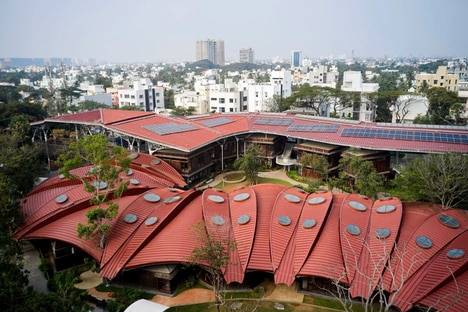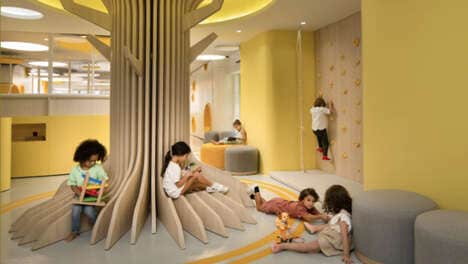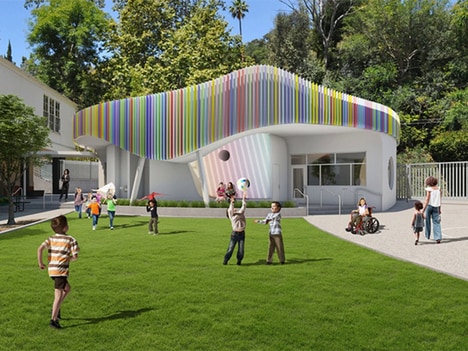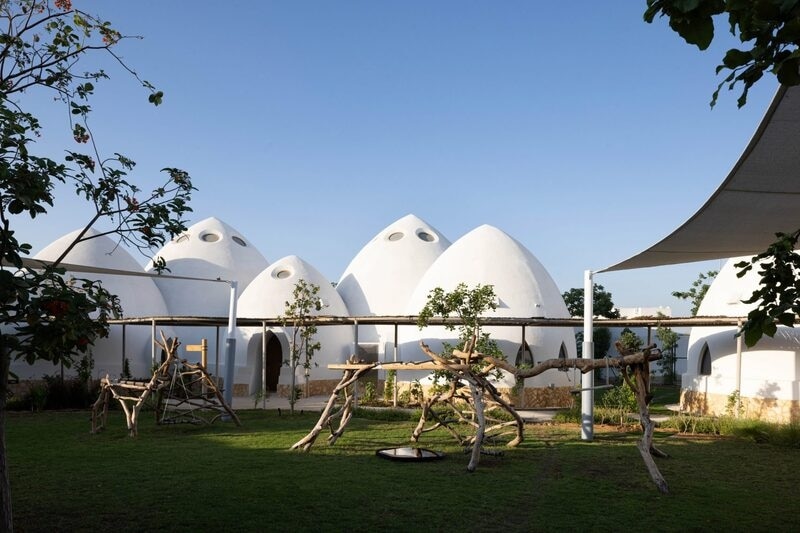
The Al Fanar School blends playful form and climate-responsive learning through clusters of dome-style classrooms that encircle shared courtyards. Designed by Emkaan in Nad Al Sheba, Dubai, the project arranges pointed concrete domes along winding paths and garden pockets to encourage exploration and interaction. Inspired by the movement of koi fish and the cultural symbolism of arches, the domes create a spiral-like plan that fosters inclusivity and discovery. Skylight openings at the tops of the domes draw in daylight, connecting students to the rhythm of the sun while supporting natural comfort indoors.
The design avoids rigid corridors, instead weaving circulation through courtyards planted with native flora. Interactive walls and varied textures reinforce sensory learning, while landscaped gardens serve as outdoor classrooms and gathering places. The thick insulated domes buffer heat, and the orientation enhances passive cooling, reducing reliance on mechanical systems. Al Fanar School demonstrates how architecture can support education, resilience, and cultural storytelling through form and atmosphere.
Image Credit: Emkaan
Why This Trend Is Growing
- Dome-style Architecture
- Dome-style architecture is gaining popularity for its ability to create immersive, culturally symbolic environments that foster community interaction and learning.
- Climate-responsive Buildings
- Climate-responsive buildings that integrate natural elements and intelligent design are becoming fundamental in reducing reliance on energy-intensive systems.
- Interactive Learning Spaces
- The emphasis on interactive learning spaces is transforming educational environments, making them more adaptable and engaging for sensory experiences.
Industries Being Reshaped
- Educational Architecture
- In the educational architecture industry, innovative designs like dome-style schools are enhancing engagement and environmental consciousness among students.
- Sustainable Construction
- The sustainable construction industry is poised to benefit from advancements in passive cooling techniques and energy-efficient building materials inspired by nature.
- Landscape Design
- Landscape design is evolving to integrate multifunctional outdoor spaces that promote learning and community interaction within educational contexts.