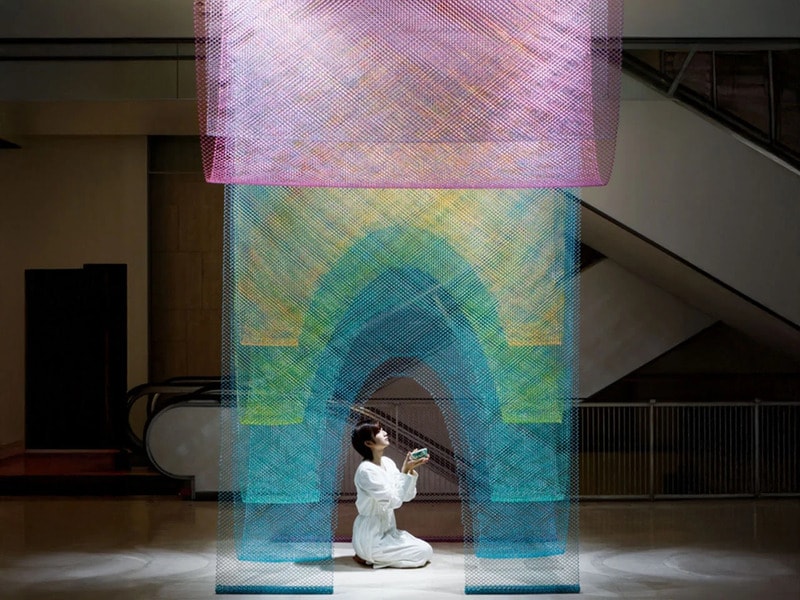
The Industrial Wire Mesh Tea House designed by Moriyuki Ochiai reinterprets the traditional Japanese tea house by wrapping the structure in layers of diamond-shaped industrial wire mesh. Rather than using solid walls and paper screens typical of tea houses, the installation uses mesh in different colors to create semi-transparent boundaries that diffuse light and cast shifting patterns of color and shadow across interior surfaces.
This approach reframes enclosure and spatial perception while preserving the contemplative functions associated with tea ceremony architecture. As visitors move through the space, the layered mesh alters sightlines and optical depth, making the environment feel simultaneously open and intimate. The mesh material, more commonly found in construction settings, becomes an active design element that mediates light and view, encouraging awareness of movement and context within the space.
Image Credit: Daisuke Shima
Why This Trend Is Growing
- Transparent Boundaries
- Harnessing semi-transparent materials like industrial wire mesh can transform traditional architecture by creating dynamic spatial experiences that bridge openness and intimacy.
- Color-mesh Architecture
- The use of colored mesh as a design element introduces a new avenue for manipulating light and atmosphere, enriching the ambiance of interior spaces through unconventional materials.
- Dynamic Light Play
- Architectural designs that use materials to cast shifting color patterns and shadows offer innovative ways to enhance visual storytelling within indoor environments.
Industries Being Reshaped
- Architectural Design
- Incorporating industrial materials into design projects allows for the creation of structures that push the boundaries of traditional design by redefining space and interaction.
- Construction Materials
- Repurposing construction materials like industrial wire mesh in creative applications opens up new possibilities for sustainable and innovative building practices.
- Interior Design
- Exciting opportunities arise from using unconventional materials to modify perceptions of space and light, enhancing both the aesthetic and functional aspects of interiors.