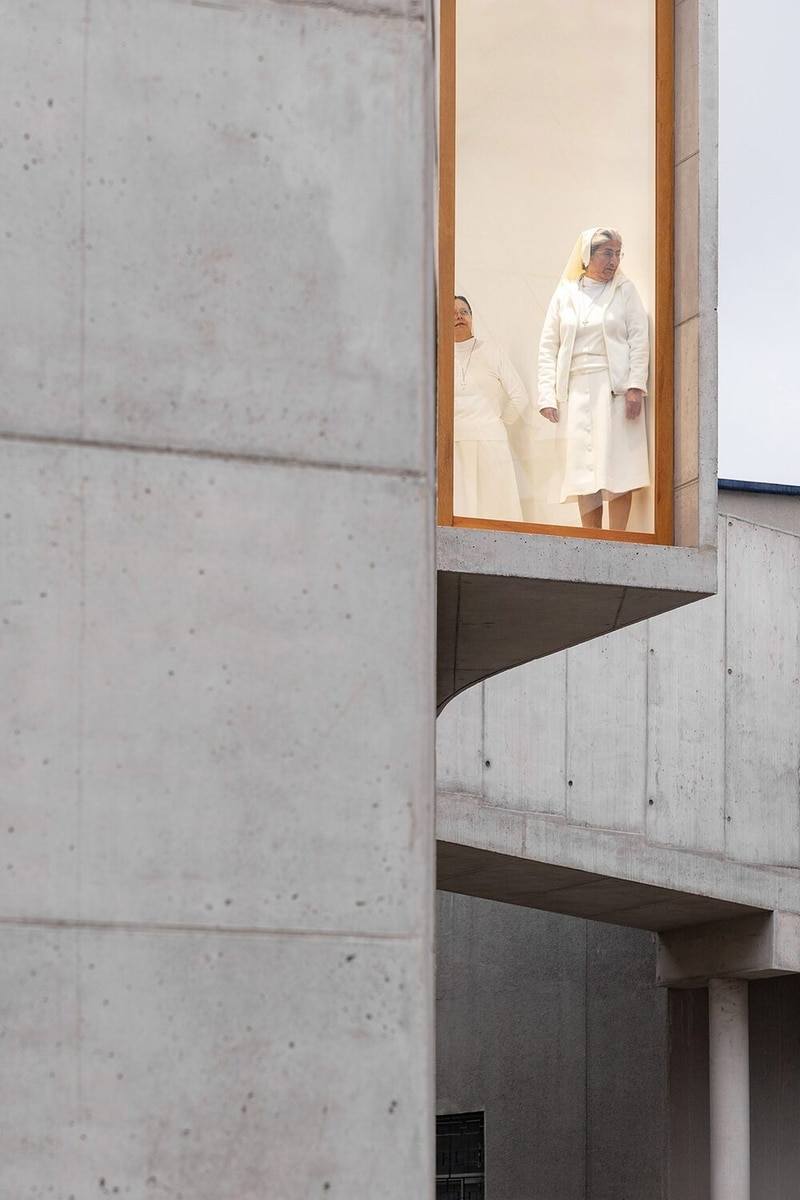
The Visual Arts Building by Studio BLUR is an educational facility designed for the Cardinal Spellman School in Quito, Ecuador, completed in 2023. Ecuadorian studio Studio BLUR organizes the project as a composition of angular volumes, arranged to define circulation and studio spaces for visual arts education. The building is constructed primarily from exposed concrete, giving the exterior a monolithic appearance that contrasts with the surrounding campus environment.
The interior is structured around a sequence of classrooms and workshop areas connected through open corridors and transitional spaces. Large openings are positioned to bring in natural light and frame views of the landscape, supporting drawing, painting, and other studio-based activities. Circulation moves through the building via stepped and ramped connections, linking different levels while maintaining visual continuity across spaces. T
Image Credit: JAG Studio
What's Driving This Trend
- Exposed-concrete Aesthetics
- The use of raw, monolithic concrete surfaces is creating demand for new low-carbon mixes and surface treatments that balance durability with refined tactile quality.
- Sculptural Modular Volumes
- Angular, interlocking building masses are prompting rethinking of modular assembly methods that allow expressive forms without bespoke on-site formwork.
- Light-framed Studio Spaces
- Large openings and framed views are emphasizing adaptive daylighting systems and flexible glazing solutions optimized for art education environments.
Who This Affects Most
- Educational-facility Design
- Design approaches that prioritize circulation, visual continuity, and multi-use studios are encouraging new pedagogical spatial models and facility planning tools.
- Architectural-concrete Supply
- Suppliers of cementitious materials are being pushed toward innovative formulations and façade technologies that reduce carbon footprint while preserving cast-in-place aesthetics.
- Prefabricated-construction
- Off-site fabrication methods for complex geometric volumes are emerging to shorten schedules and lower costs for sculptural institutional buildings.