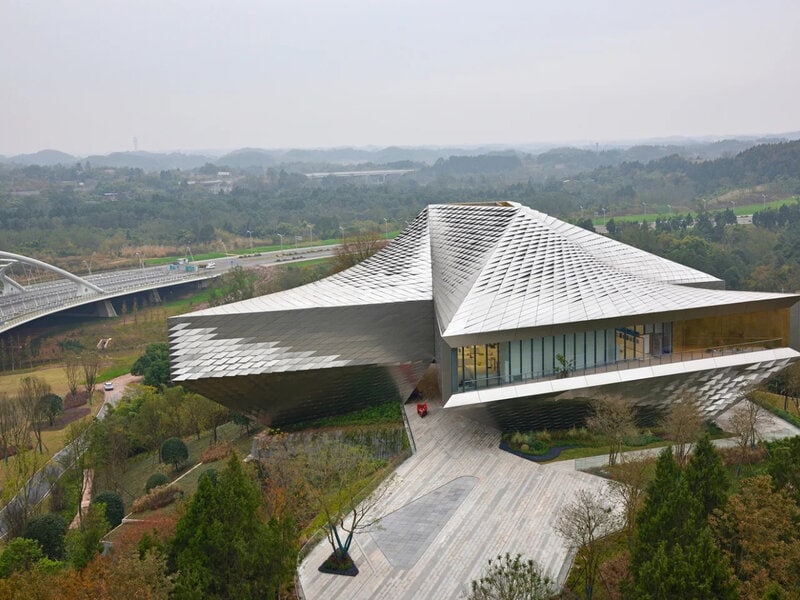
The Chengdu Pavilion serves as an exhibition and information center for the Chengdu Future Science and Technology City, a 1,200-acre master-planned district in Sichuan Province. Designed by IwamotoScott Architecture, the building is formed from three intersecting triangular volumes oriented toward Tianfu International Airport, the developing Future City, and Jiangxi River Park. A central crystalline atrium connects the three wings, while roof apertures introduce controlled natural light and a ground-level breezeway creates a public passage beneath the structure.
A tessellated stainless-steel facade wraps the pavilion with localized openings that regulate visual connections between the interior and surrounding landscape. The exterior references the studio's earlier speculative research into adaptive architectural envelopes while translating the concept into a built public project. A companion lookout tower continues the metallic cladding and twisting geometry established by the main structure.
Image Credit: IwamotoScott Architecture
Key Themes Behind This Trend
- Crystalline Civic Pavilions
- Triangular, intersecting public structures create memorable anchors for emerging districts while blending exhibition, wayfinding, and landmark functions into one architectural identity.
- Adaptive Metal Facades
- Tessellated stainless-steel envelopes with localized openings demonstrate how expressive cladding can regulate light, views, and environmental experience in cultural infrastructure.
- Integrated Public Breezeways
- Ground-level passages beneath elevated civic buildings signal a shift toward architecture that preserves pedestrian flow while adding shaded, semi-public gathering space.
Where This Applies
- Architecture
- Experimental geometries and performative building skins expand the role of design firms in shaping signature destinations for science, technology, and innovation districts.
- Urban Development
- Master-planned future cities gain differentiation through sculptural information centers that communicate district identity before full neighborhood buildout is complete.
- Building Materials
- Advanced metal cladding systems open opportunities for manufacturers to support visually complex facades that combine durability, customization, and environmental modulation.