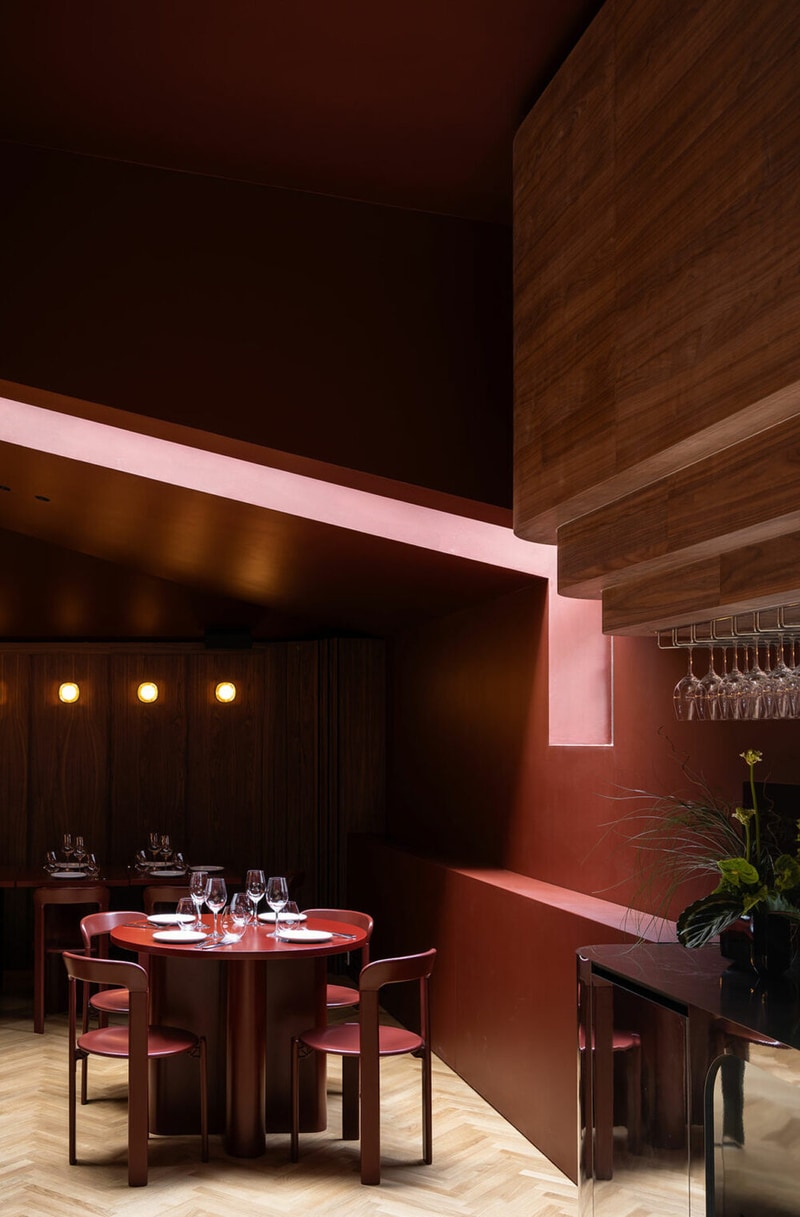
TABRA by Andreea Cornila presents a restaurant interior built around saturated color, controlled lighting, and spatial contrast. TABRA by Andreea Cornila centers a burgundy-drenched palette applied across walls, ceilings, seating, and drapery, forming a continuous visual field throughout the space. A singular skylight introduces a focused beam of natural light, while small circular wall fixtures provide diffused illumination that interacts with glossy tables and textured upholstery.
Andreea Cornila’s layout organizes the interior through shifting volumes and material transitions that guide movement between dining areas and the bar. Curved chrome cladding wraps the bar structure, reflecting the herringbone flooring, while suspended glass racks and built-in cabinetry define vertical space. Textile archways reference the site’s historical layout, replacing original openings with upholstered portals that maintain circulation while altering spatial weight. An open kitchen sits within view, removing separation between preparation and dining areas.
Image Credit: Andreea Cornila
Why This Trend Is Growing
- Monochrome Immersive Interiors
- Immersive single-color schemes that integrate seating, walls and fixtures to shape mood and perceived spatial continuity across an entire venue.
- Light-focused Spatial Design
- Focused natural skylights combined with targeted diffused fixtures creating layered illumination strategies that define zones and highlight material contrasts.
- Textile-defined Circulation
- Upholstered archways and fabric portals used as transitional elements that both reference historical openings and modulate circulation and acoustics.
Industries Being Reshaped
- Hospitality and Dining
- Dining operations leveraging cohesive color narratives and visible kitchens to craft memorable, emotionally driven guest experiences that differentiate brands.
- Commercial Interior Design
- Design studios exploring material transitions and curved reflective surfaces to create compact layouts that feel expansive and theatrically staged.
- Lighting and Material Manufacturing
- Producers developing integrated fixtures and glossy or textured surfaces engineered to interact with controlled light beams for enhanced visual depth.