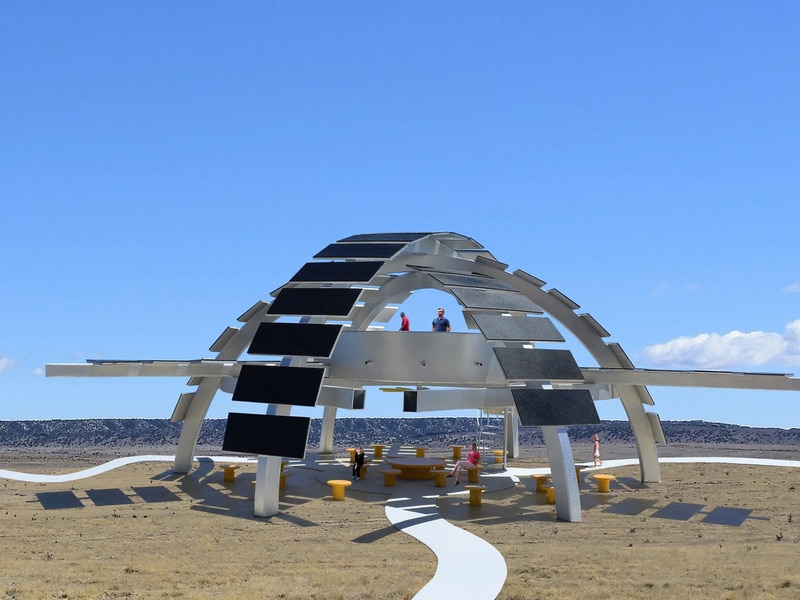
The Solar Electric Pavilion powers the grid and charges phones from its seats by combining renewable energy infrastructure with public seating in a single outdoor structure designed by Michael Jantzen. The pavilion is built around an open steel framework that supports sixty photovoltaic panels arranged across curved and linear beams, generating electricity that is primarily fed into the local power grid. A portion of the energy is stored on site in battery units concealed within cylindrical seating elements positioned beneath the canopy.
The shaded pavilion functions as a gathering space, with integrated tables, seating, and a ceiling fan powered by the stored solar energy. Users can charge phones and small devices directly from the seating units, extending the pavilion’s role beyond shelter into everyday utility. A raised circular platform accessed by a spiral stair provides elevated views and reveals the pavilion’s structural system.
Image Credit: Michael Jantzen
What's Driving This Trend
- Multi-functional Public Spaces
- Incorporating renewable energy features into urban environments is expanding the role of public spaces to serve as both community hubs and sustainable power sources.
- Integrated Renewable Infrastructure
- Blending renewable energy technologies with urban designs creates infrastructure that not only supplies power but also enhances local aesthetics and functionality.
- On-site Energy Storage
- Developing on-site energy storage solutions in communal areas allows for efficient energy management and promotes localized energy independence.
Who This Affects Most
- Urban Design
- The integration of energy-generating structures into city landscapes is dramatically reshaping how urban spaces are conceptualized and utilized.
- Renewable Energy Technology
- Advancements in photovoltaic technologies and their applications in public infrastructure foster new avenues for sustainable urban development.
- Consumer Electronics
- The embedding of device charging capabilities within urban furniture signifies a shift towards seamlessly integrating technology with daily urban life.