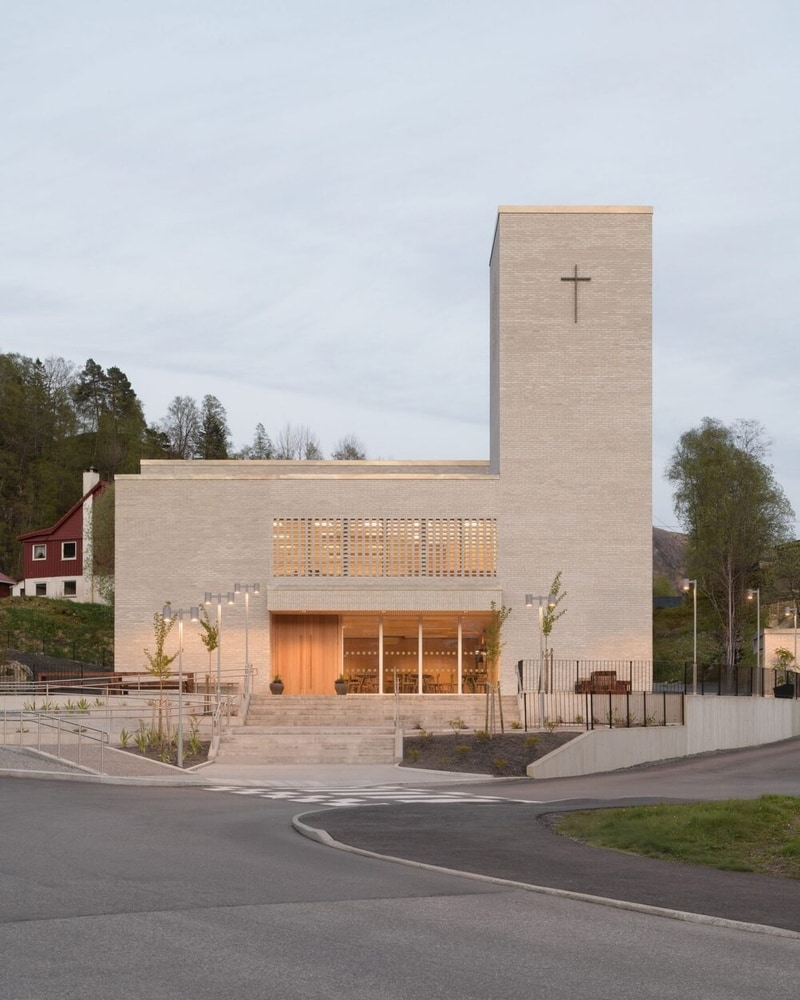
The Sædalen Kirke church by Koht Arkitekter is a contemporary parish building located in Bergen, Norway, designed to serve both religious and community functions. The Sædalen Kirke project sits on elevated terrain overlooking surrounding meadows and forest, establishing a visible landmark while maintaining close connections to the landscape. The architecture organizes the site along a processional axis leading from the road junction toward the altar, guiding visitors through terraces and gathering spaces before entering the church interior.
Sand-toned brick defines the building’s exterior and is used across multiple elements including volumes, perforated screen walls, and tower components. The consistent material palette helps unify the structure while allowing variations in light and transparency across different spaces. Inside, the church contains a central gathering area that can host events beyond religious services, supporting weekly community activities alongside worship.
Image Credit: Thurston Empson
What's Driving This Trend
- Adaptive Sacred Spaces
- A shift toward multipurpose sacred spaces redefines religious buildings as hybrid hubs for worship, social programming, and civic gatherings, opening possibilities for flexible spatial systems and scheduling platforms.
- Material Uniformity for Identity
- Consistent use of a single material palette like sand-toned brick creates a cohesive architectural identity that enables modular prefabrication and new surface-based smart integration opportunities.
- Processional Site Design
- Emphasis on articulated approach routes and terraces positions landscape-led circulation as a design lever for immersive wayfinding experiences and contextual placemaking services.
Who This Affects Most
- Religious Institutions
- Many congregations are evolving into community-focused organizations that present demand for programmatic flexibility, digital engagement tools, and revenue models beyond traditional giving.
- Community Center Development
- Local governments and nonprofits investing in multipurpose facilities reveal opportunities for standardized, low-cost construction systems tailored to mixed-use scheduling and shared governance.
- Architectural Materials Manufacturing
- Producers of brick, screening elements, and facade systems face potential disruption through demand for customizable, sustainable façade modules and integrated environmental-performance features.