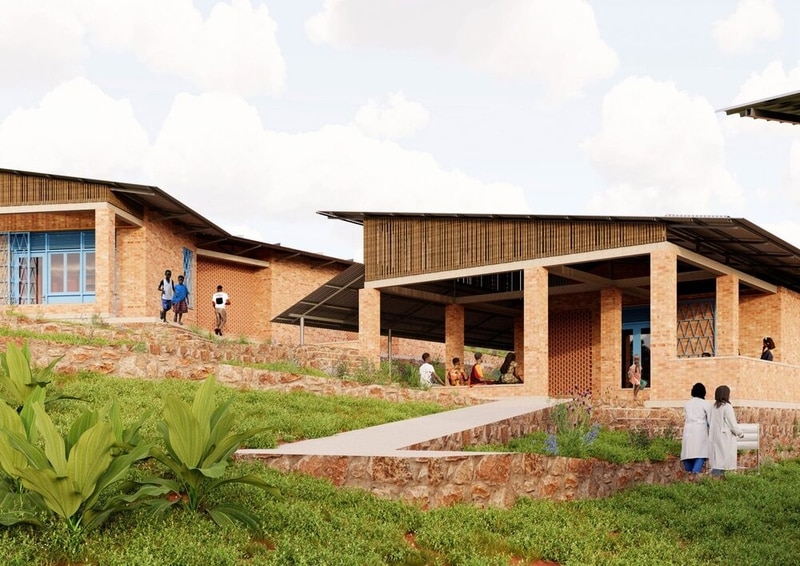
The Ineza Clinic by Kéré Architecture is a healthcare complex located in the Bubanza region of Burundi, designed by Francis Kéré’s Berlin-based studio. The project is planned as a 3,000-square-metre campus that improves access to medical care for rural communities, focusing on maternity and surgical services. The design distributes the program across ten separate pavilions connected by a zigzagging road that ascends the hillside. This layout organizes public, clinical, and support spaces while responding to the steep terrain and limited infrastructure.
The buildings are constructed using locally sourced clay bricks, stone, and timber to reduce transport demands and support regional production. Perforated brick walls provide ventilation and filtered light, while elongated building forms minimize excavation. Roof systems are designed to handle seasonal rainfall and promote airflow through natural cross-ventilation and chimney structures.
Image Credit: Kéré Architecture
Key Themes Behind This Trend
- Vernacular Materials and Local Production
- The use of locally sourced clay, stone, and timber creates opportunities for integrated supply chains that reduce costs and strengthen regional economies.
- Perforated-brick Passive Ventilation
- Perforated masonry systems that provide filtered light and cross-ventilation suggest new climate-responsive envelope solutions that lower reliance on mechanical HVAC.
- Distributed Pavilion Healthcare
- Low-rise, multi-pavilion campus layouts adapted to steep terrain indicate a shift toward modular, site-specific healthcare models that improve access in rural regions.
Where This Applies
- Rural Healthcare Infrastructure
- Decentralized clinic typologies tailored to challenging topography present possibilities for scalable platforms that expand primary and maternal care coverage.
- Sustainable Construction Materials
- Demand for low-embodied-energy bricks and locally produced components points to market potential for circular-material manufacturing and decentralized production technologies.
- Architectural Design and Site-responsive Planning
- Design strategies that minimize excavation and exploit natural ventilation reveal avenues for performance-driven design services and simulation-led building systems.